
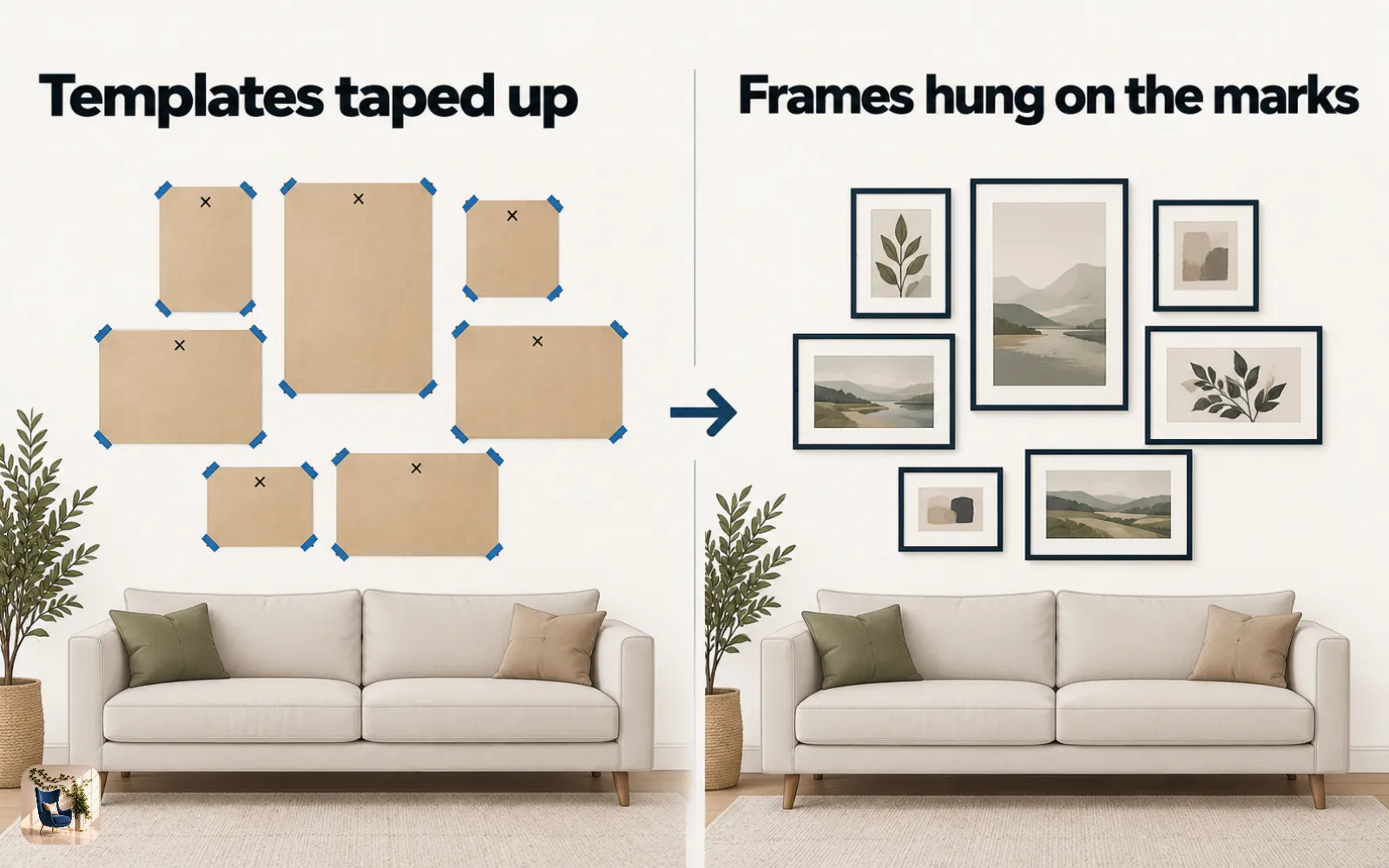
Choose one layout first: a grid, a salon-style cluster, a single line, or a staircase. Keep 2 to 3 inches between frames, the spacing Frameology recommends, and treat the whole group as one large piece. Then cut paper templates the size of each frame, tape them up, and adjust them before you put a single nail in the wall.
Most gallery walls go wrong in the spacing. Even gaps make mismatched frames look planned.
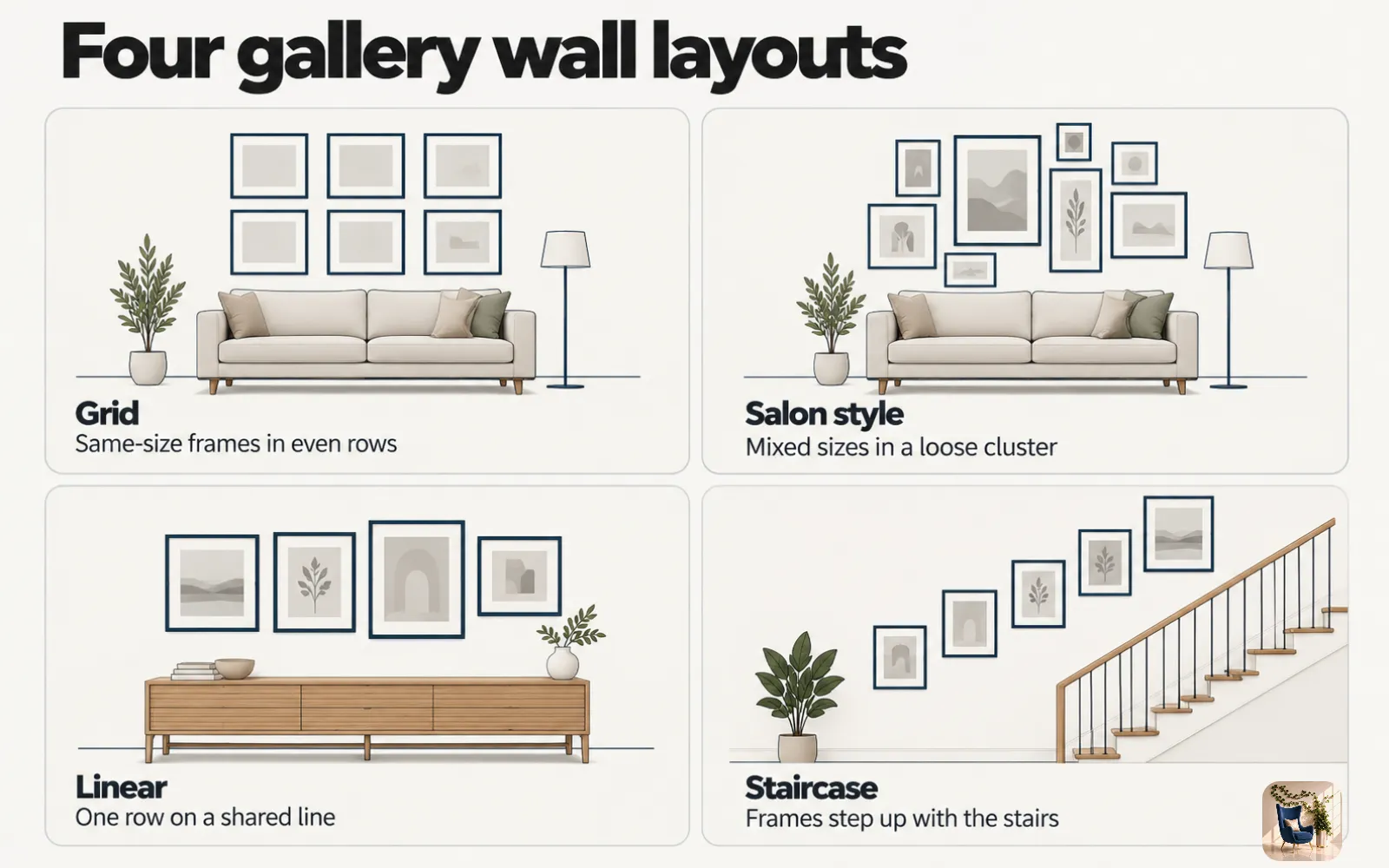
The four main gallery wall layouts
Each layout suits a different wall and a different mix of art. Match the layout to what you own.
| Layout | How it works | Best for | Spacing |
|---|---|---|---|
| Grid | Same-size frames in even rows and columns | Matching frames and a formal look | About 2.5 inches |
| Salon style | A loose cluster of mixed sizes with no strict alignment | Collections of mixed art and frames | 2 to 3 inches |
| Linear | One row of frames along a shared line | Above a sofa, bed, or console | About 3 inches |
| Staircase | Frames step up along the line of the stairs | Stairwells and hallways | Even gaps, stepped up with each stair |
Spacing figures come from CustomPictureFrames' layout guide. For a staircase, Frameology suggests moving each frame about 4 to 6 inches across and 6 to 8 inches up from the last.
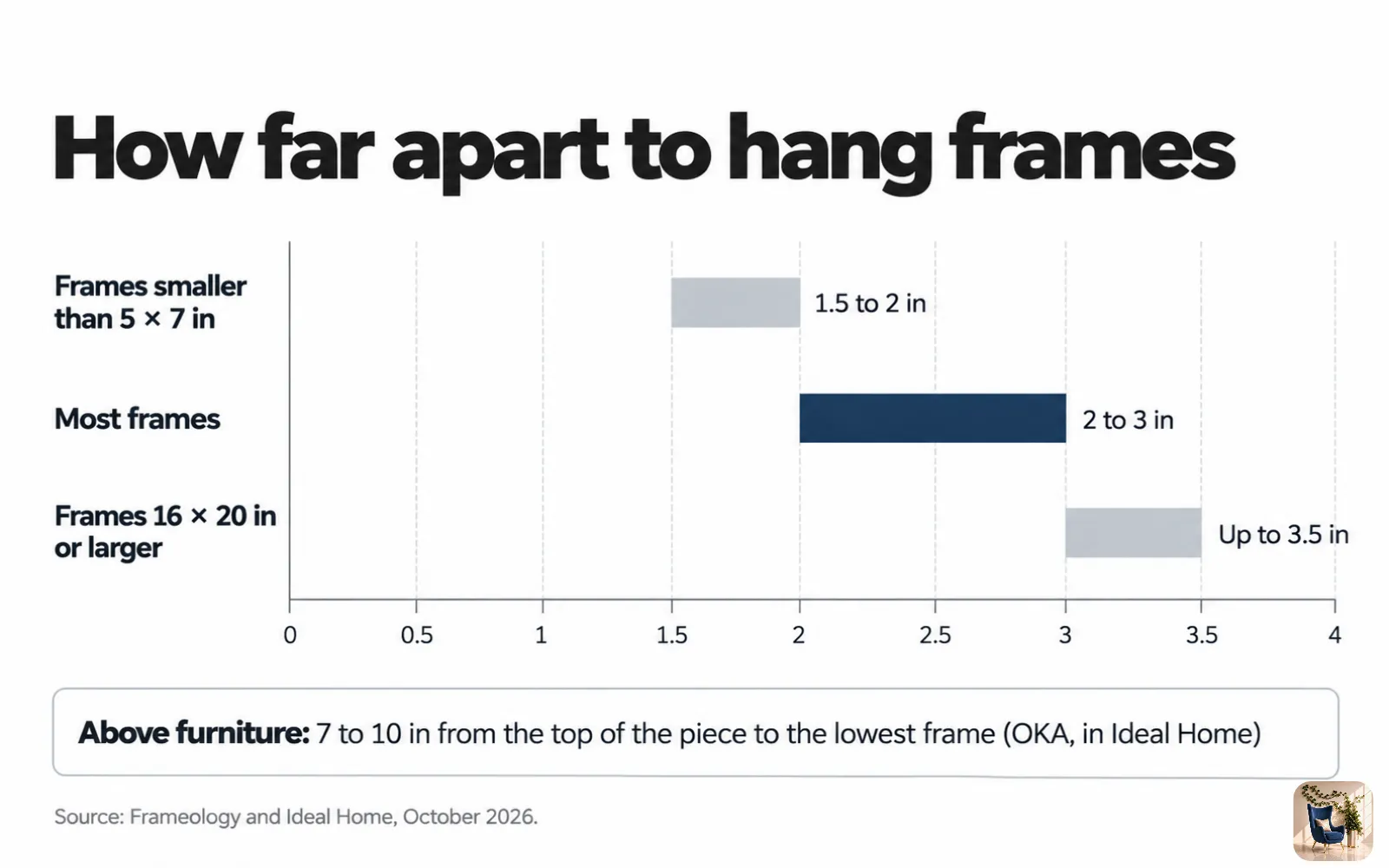
How to space and mix frame sizes
Frameology puts the ideal gap at 2 to 3 inches, stretching to 3.5 inches for frames 16 by 20 inches or larger and tightening to 1.5 to 2 inches for frames smaller than 5 by 7. Over furniture, OKA's Sue Jones told Ideal Home to hang the lowest frame 7 to 10 inches above the top of the piece. Center the whole group at eye level, 57 inches from the floor, the rule explained in How High Should I Hang Art? below.
When you mix sizes, start with the largest piece near the center and build out. Frameology suggests letting the outer edges form a loose rectangle and keeping the inside gaps equal.
How to plan it with paper templates
Step 1: Lay the frames on the floor
Arrange the frames on the floor in front of the wall until the group looks balanced, then take a phone photo of it.
Step 2: Cut a paper template for each frame
Trace each frame on kraft paper or printer paper, cut it out, and mark where the hanging hardware sits on the back.
Step 3: Tape the templates to the wall
Use painter's tape and keep the gaps even. Live with the layout for a day and move pieces until it looks right.
Step 4: Preview the wall on a photo
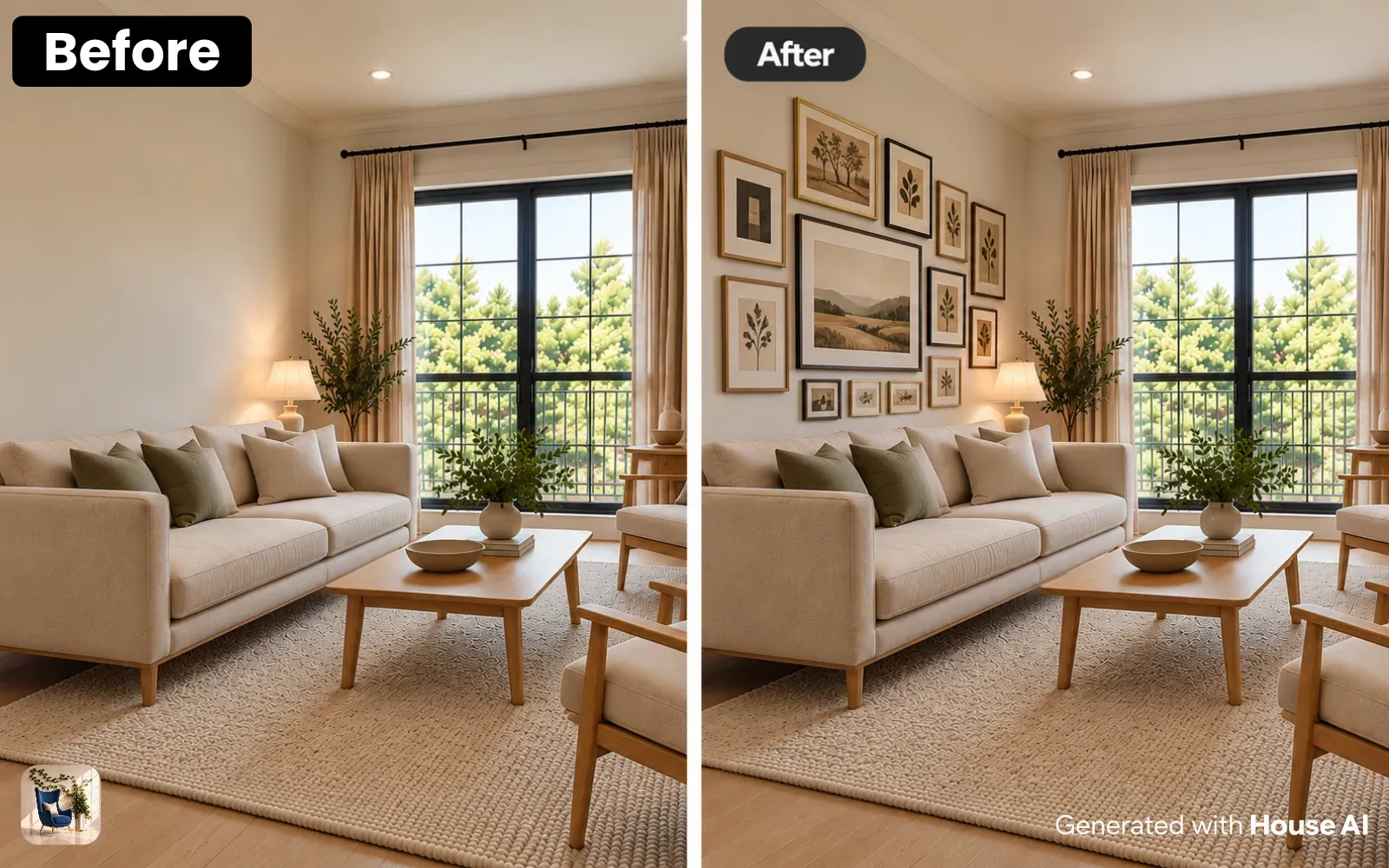
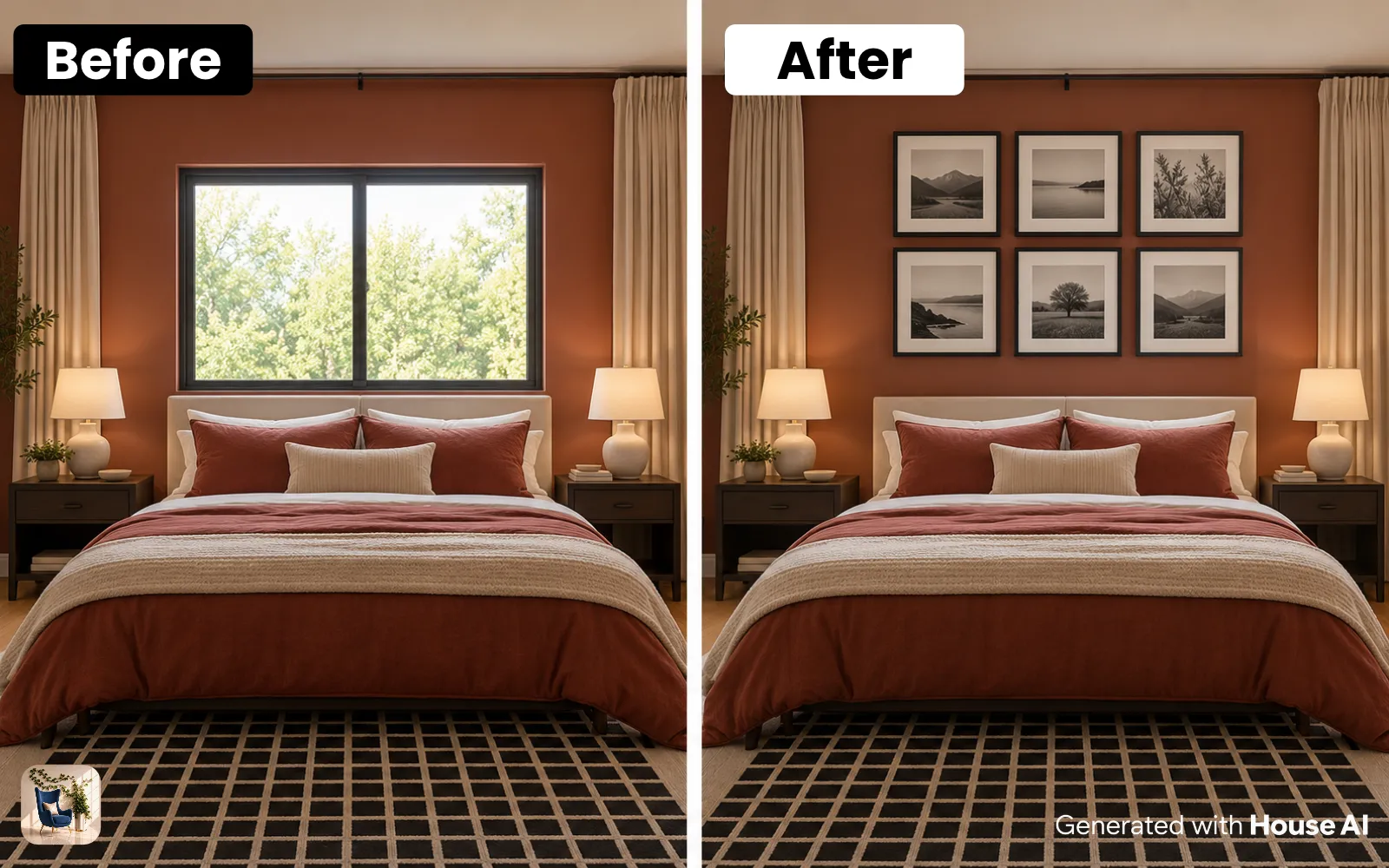
Upload a photo of the room to House AI and describe the gallery wall in your own words. It shows the look in about 15 seconds, but it doesn't measure your wall and frame sizes can drift, so trust the templates for placement.
Step 5: Mark the nail spots and hang
Frameology's method is to mark nail spots straight through the templates, pull the paper off, and hang each frame on its mark.
Frequently asked questions
How far apart should frames be on a gallery wall?
2 to 3 inches for most frames, according to Frameology, and up to 3.5 inches for large frames.
Do all the frames on a gallery wall need to match?
No. A salon-style wall mixes sizes and frames on purpose. Even spacing and one or two repeated colors hold it together.
How high above a sofa should a gallery wall start?
OKA's Sue Jones suggests 7 to 10 inches between the top of the furniture and the bottom of the lowest frame.
Keep reading
- How High Should I Hang Art?
- How Do I Style a Bookshelf?
- How Do I Make a Room Feel Cozy?
- Small Living Room Ideas: Layouts, Furniture, and Storage That Fit
- Wall Design
Sources: Daniel Koren, "Easy gallery wall templates for arranging living room frames," Frameology, August 12, 2026. CustomPictureFrames Team, gallery wall layouts guide, CustomPictureFrames, October 25, 2024, updated April 29, 2026. Sara Hesikova, "Experts take the guesswork out of creating the perfect gallery wall," Ideal Home, September 2, 2023. All checked October 17, 2026. House AI figures come from the House AI app.