Most fireplace design comes down to three choices: the surround material, the fuel type, and how you style the mantel. Brick and stone feel warm and traditional, tile and plaster read cleaner and more modern, and wood paneling turns the whole wall into a feature. House AI can show each surround on a photo of your own living room in about 15 seconds.
A fireplace is usually the first thing you see in a living room, so small changes to it change the whole room. This guide compares the five most common surround materials, explains what wood, gas, and electric fireplaces each need, covers the clearance rules that limit what you can put near the opening, and ends with a simple formula for styling the mantel.
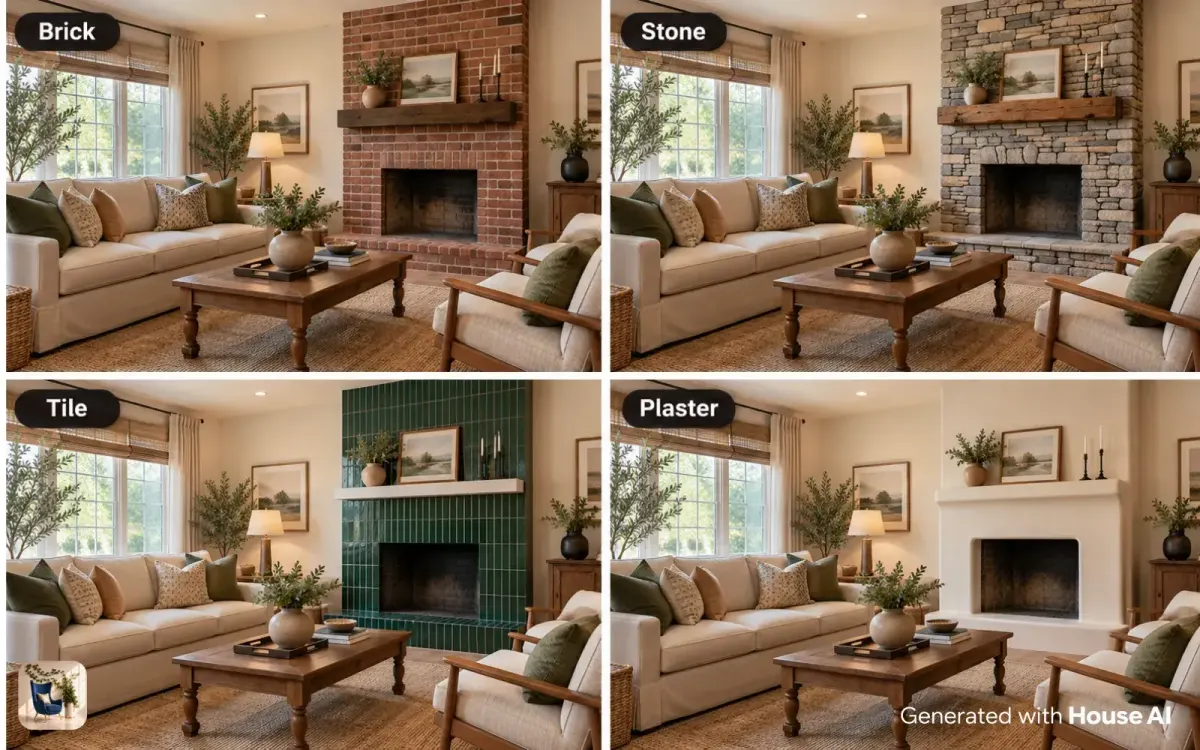
Fireplace surround materials compared
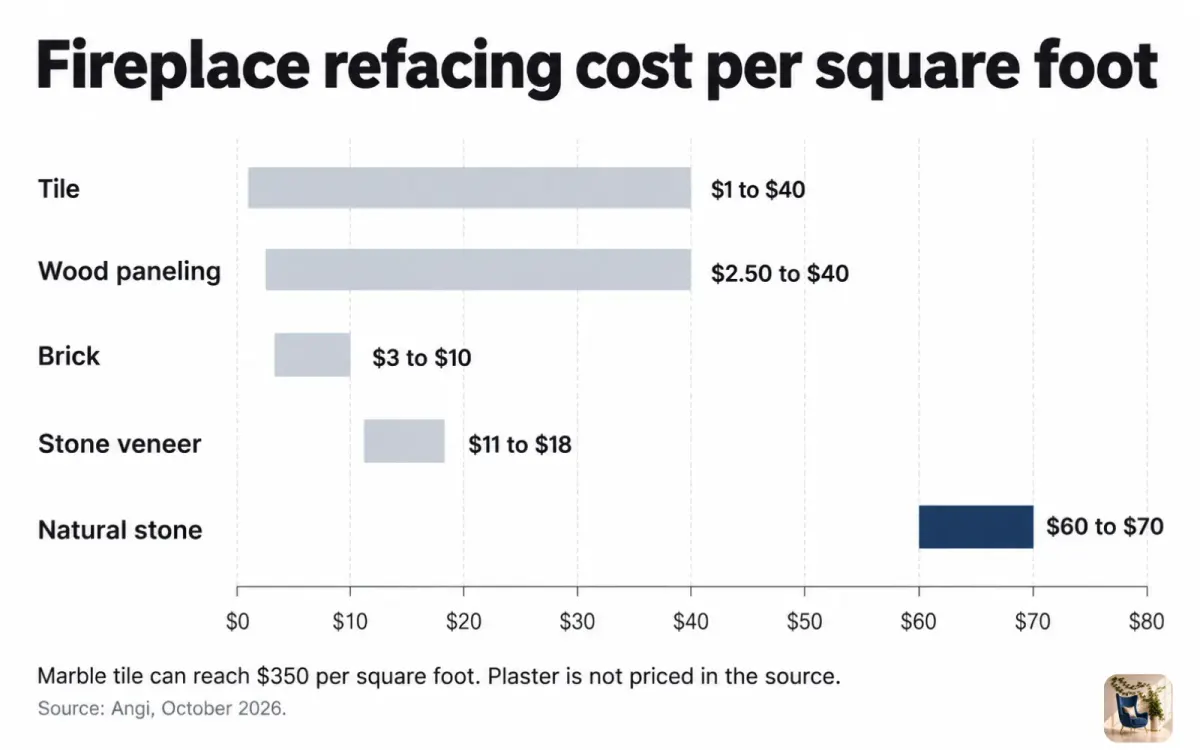
The surround material sets the style of the fireplace more than anything else. It also sets most of the cost, since refacing a surround is priced by the square foot. Angi's fireplace remodel guide, updated September 18, 2026, puts the national average remodel at $1,200 and refacing at $600 to $4,500.
| Material | The look | Refacing cost per square foot (Angi) | Upkeep | Best for |
|---|---|---|---|---|
| Brick | Warm, textured, and traditional; can be painted | $3 to $10 | Dust the mortar joints; paint needs touch-ups near the opening | Traditional, farmhouse, and industrial rooms |
| Stone | Heavy and natural, from fieldstone to slate | $60 to $70 for natural stone; $11 to $18 for stone veneer | Rough stone collects soot and dust in its gaps | Rustic rooms and tall walls that need a strong anchor |
| Tile | Anything from plain white to bold color or pattern | $1 to $40; marble tile up to $350 | Glazed tile wipes clean; grout needs sealing | Modern rooms and small budgets |
| Plaster | Smooth and soft, with no grout lines and often rounded edges | Not priced in Angi's guide | Hairline cracks can need patching over time | Mediterranean, Japandi, and minimalist rooms |
| Wood paneling | Paneled or slatted wall that frames the firebox | $2.50 to $40 | Must stay outside the clearance zone around the opening | Turning the whole fireplace wall into a feature |
The spread inside each row is large because the material grade matters more than the category. A budget stone veneer costs $6 to $10 per square foot in Angi's figures, while higher-end veneer runs $20 to $100. Measure the surround before you price it, and add the hearth, which Angi prices separately at $3 to $200 per square foot.
Brick and stone surrounds: texture that anchors the room
Brick and stone suit rooms that need a strong focal point. Exposed brick works in traditional, farmhouse, and industrial rooms, and reclaimed brick that matches the age of the house is a common choice for restorations. If the brick is the wrong color, painting it is the fastest fix. Angi's design guide, updated August 3, 2026, recommends a heat-resistant paint for that job.
Stone ranges from rough fieldstone to flat slate and smooth marble. Natural stone is the priciest surround in Angi's figures, so stone veneer is the usual compromise when you want the look on a full wall. Floor-to-ceiling stone needs a big room. On a small wall, run stone only up to the mantel and paint the wall above it.
Tile, plaster, and wood paneling: cleaner, more modern options
Tile is the most flexible surround. A plain white tile disappears into the wall, while a deep green or patterned tile becomes the main color in the room. Because tile is priced from $1 per square foot, it is also the cheapest way to change a fireplace without rebuilding it.
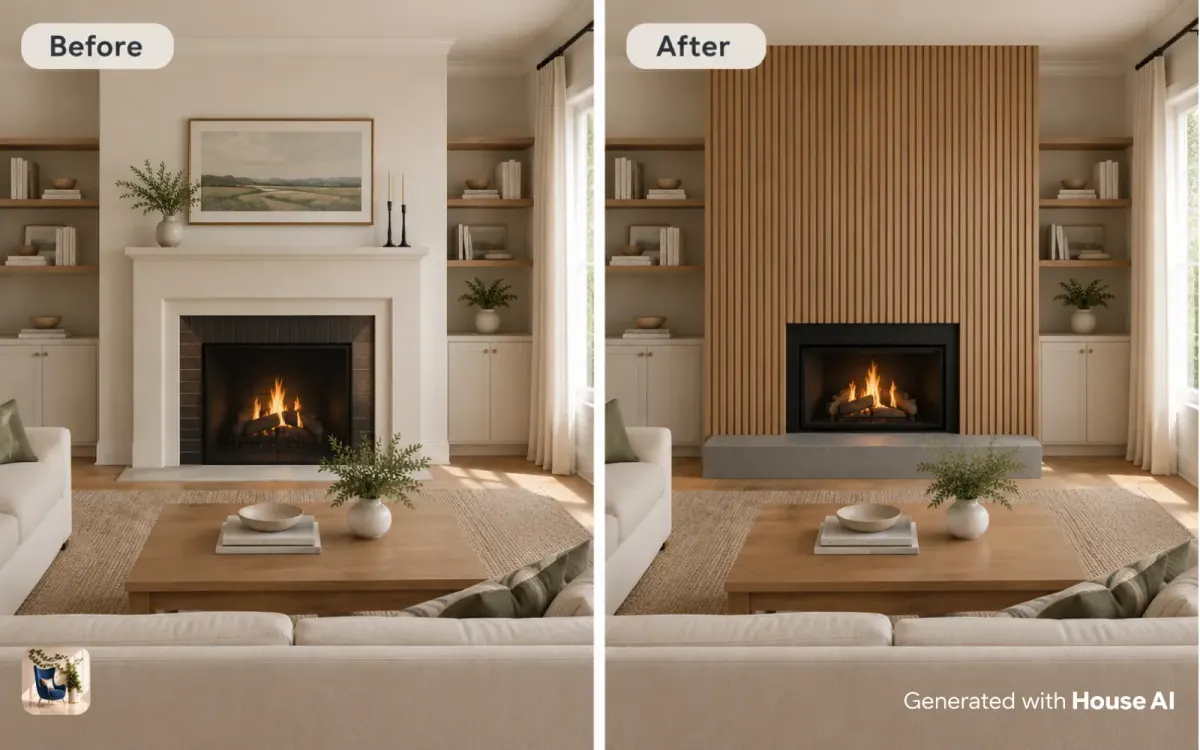
Plaster gives a soft, smooth surround with no grout lines, and it can wrap around curves. It suits Mediterranean, Japandi, and minimalist rooms. Wood paneling, from classic raised panels to vertical slats, works when you want the whole wall to read as one piece of furniture. Wood burns, so keep it outside the clearance zone described below.
Wood, gas, or electric: what each fireplace type needs
The fuel type decides what has to be built behind the surround. A wood fireplace needs a working chimney, a gas fireplace needs a gas line, and an electric fireplace needs only power. The figures below come from HomeAdvisor's fireplace installation guide, updated June 20, 2026.
| Type | What it needs | Installed cost (HomeAdvisor) | Ongoing upkeep |
|---|---|---|---|
| Wood | A usable chimney; without one, up to $3,300 for a new vent pipe | Not listed as a single range | A chimney sweep, about $255 a year |
| Gas | A gas line; HomeAdvisor's example is $200 for labor and $3,600 for a gas insert | $2,500 to $10,000 | Regular service of the gas unit |
| Electric | Power; some units need a dedicated 120-volt outlet, and an electrician costs $150 to $200 | $1,000 on average | No chimney, because electric units produce no smoke |
Switching fuels is common. Angi puts a wood-to-gas conversion at about $3,000 on average, with a range of $500 to $5,500. Because an electric unit skips the chimney, it can go on almost any wall, which makes it the easiest way to add a fireplace to a room that never had one.
Clearance rules to check before you add a mantel or trim
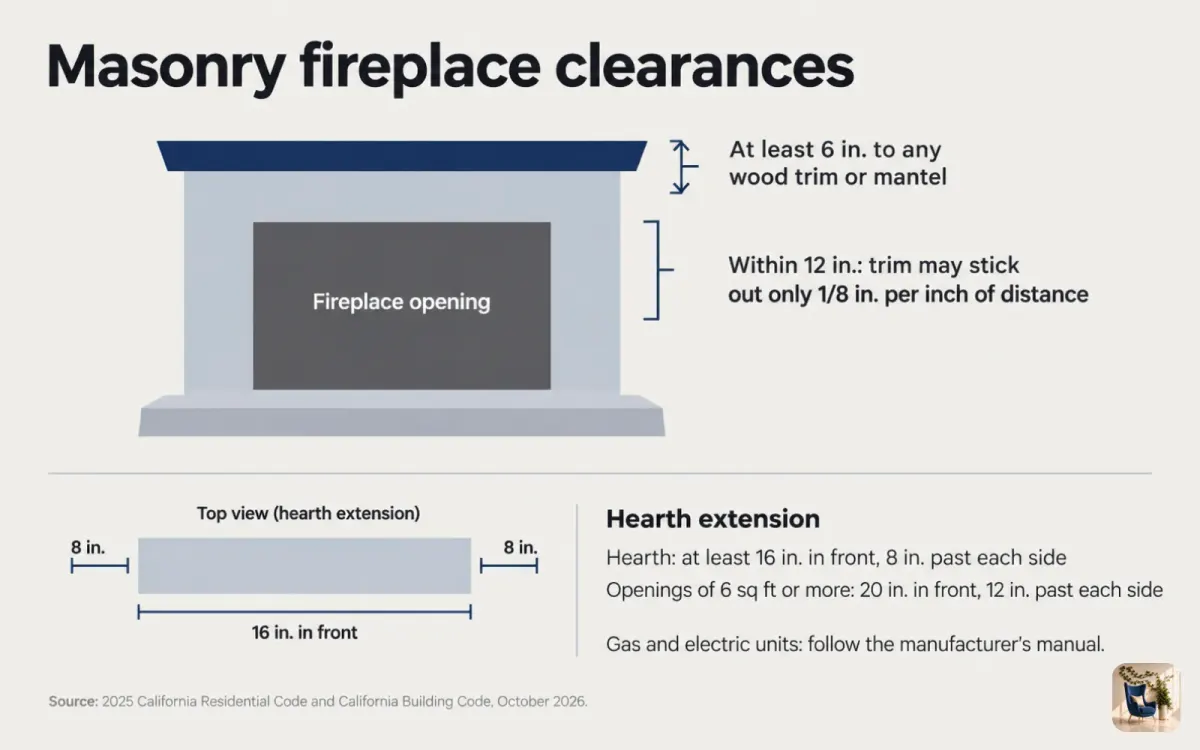
For masonry fireplaces, building codes limit how close anything that can burn sits to the opening. The International Residential Code rule, as printed in the 2025 California Residential Code and California Building Code, keeps combustible mantels and trim at least 6 inches from the fireplace opening. Within 12 inches of the opening, combustible material can project no more than 1/8 inch for each inch of distance, so trim 8 inches from the opening can stick out 1 inch at most.
The hearth extension has its own minimum. The same code requires it to reach at least 16 inches in front of the opening and 8 inches past each side, or 20 inches in front and 12 inches past each side when the opening is 6 square feet or larger. Gas and electric units are different products, so follow the clearances in the manufacturer's installation manual, and check with your local building department before you build. A TV over the fireplace raises its own questions about heat and viewing height, so plan the mantel and the TV together.
Mantel options: shelf, beam, or full surround
A mantel can be a simple shelf, a chunky wood beam, or a full surround with legs that frames the opening. The price swings widely. In Angi's guide, a prefabricated wood mantel costs $300 to $2,000, a refurbished antique mantel costs $500 to $1,000 customized and installed, and a custom mantel costs $2,000 to $5,000. Prefabricated marble or limestone mantels run $8,000 to $20,000.
Match the mantel to the surround. A rough oak beam suits brick and stone. A slim painted shelf suits tile. A plaster surround often needs no separate mantel at all, just a ledge formed in the same plaster.
How to style a mantel in six steps
Most well-styled mantels follow the same formula: one large anchor, height at the ends, smaller pieces in between, and one living thing. Work through it in this order.
Step 1: Clear the mantel and measure it
Take everything off, dust it, and measure the length and depth of the shelf. Note how much wall sits above it, since that space decides how big your anchor piece can be.
Step 2: Hang or lean one large anchor
Center a mirror or a piece of art above the mantel, or lean it against the wall for a looser look. It should be the biggest thing on the mantel and narrower than the shelf, so the ends stay free.
Step 3: Choose symmetric or asymmetric balance
For a formal room, put a matching pair at each end, such as two candlesticks or two vases. For a relaxed room, put one tall piece on one side and balance it with a low group of objects on the other.
Step 4: Fill in with groups of three and varied heights
Add small objects in groups of three, mixing tall, medium, and short pieces so the eye moves along the shelf. Layer some in front of others to add depth, and leave gaps so each group can breathe.
Step 5: Add one natural element
Finish with greenery, branches, or dried stems for life and texture. Keep anything flammable well back from the opening, and take it down before you light a fire.
Step 6: Try the look on a photo first
Upload a photo of your living room to House AI, set the room type to living room, and describe the surround and mantel in your own words, such as a white plaster fireplace with an oak beam mantel and a round mirror. Every user gets 3 free designs a day, so you can compare a few ideas on the same wall.
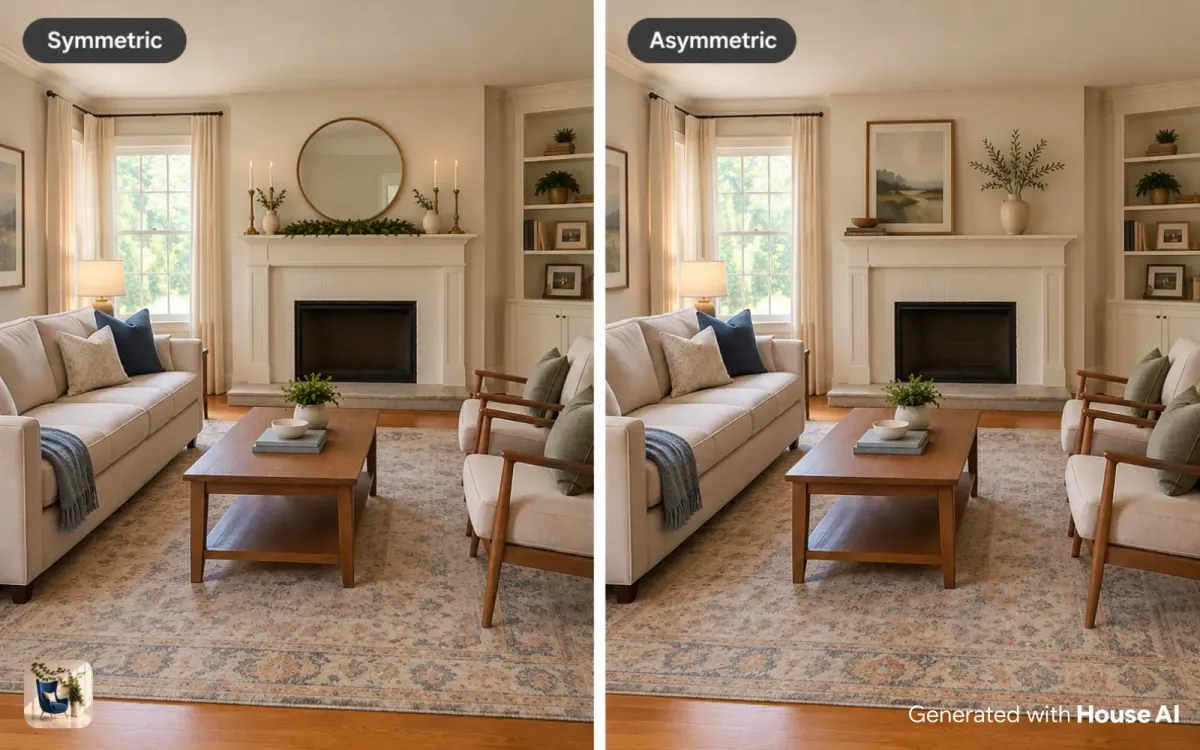
An AI render shows how a surround or mantel looks in your room, but it doesn't measure the fireplace or check clearances to the opening. Small details, like the grout lines or the depth of a mantel shelf, can drift from the real thing, and the color on your screen is not the color of the brick, tile, or paint. Use the render to choose a direction, then measure, check the code, and order samples.
Design any room, shop or space with House AI in about 15 seconds. 1 free design a day.
Get Started TodayFrequently asked questions
What is the cheapest way to update a fireplace?
Paint the brick or reface the surround in tile. Angi prices fireplace painting at $350 to $650 and tile refacing from $1 per square foot.
What is the best material for a fireplace surround?
It depends on the room. Brick and stone suit traditional and rustic rooms, tile and plaster suit modern ones, and tile gives the widest choice of looks for the money.
How far does a wood mantel have to be from the fireplace opening?
At least 6 inches for a masonry fireplace under the International Residential Code rule. Within 12 inches, it can project only 1/8 inch for each inch of distance from the opening.
Does an electric fireplace need a chimney?
No. HomeAdvisor notes that electric units produce no smoke and skip the chimney, though some need a dedicated 120-volt outlet.
How do you style a mantel without clutter?
Start with one large anchor, add a pair or a tall piece at the ends, and group small objects in threes. Leave gaps between groups.
Can AI show a new fireplace surround on my own room?
Yes. Upload a photo to House AI and describe the surround you want, and it shows the look in about 15 seconds. It doesn't measure the fireplace, so confirm sizes and clearances yourself.
Keep reading
- Small Living Room Ideas: Layouts, Furniture, and Storage That Fit
- Fall Decor Ideas for 2026
- How High Should I Hang Art?
- How Do I Make a Room Feel Cozy?
- Wall Design
Sources: Angi, "How Much Does a Fireplace Remodel Cost?", updated September 18, 2026. Angi, fireplace materials and design ideas guide, updated August 3, 2026. HomeAdvisor, "How Much Does Fireplace Installation Cost?", updated June 20, 2026. 2025 California Residential Code, section R1001.10, and 2025 California Building Code, section 2111.12, which carry the International Residential Code fireplace clearance rules. All checked October 17, 2026. House AI figures come from the House AI app.