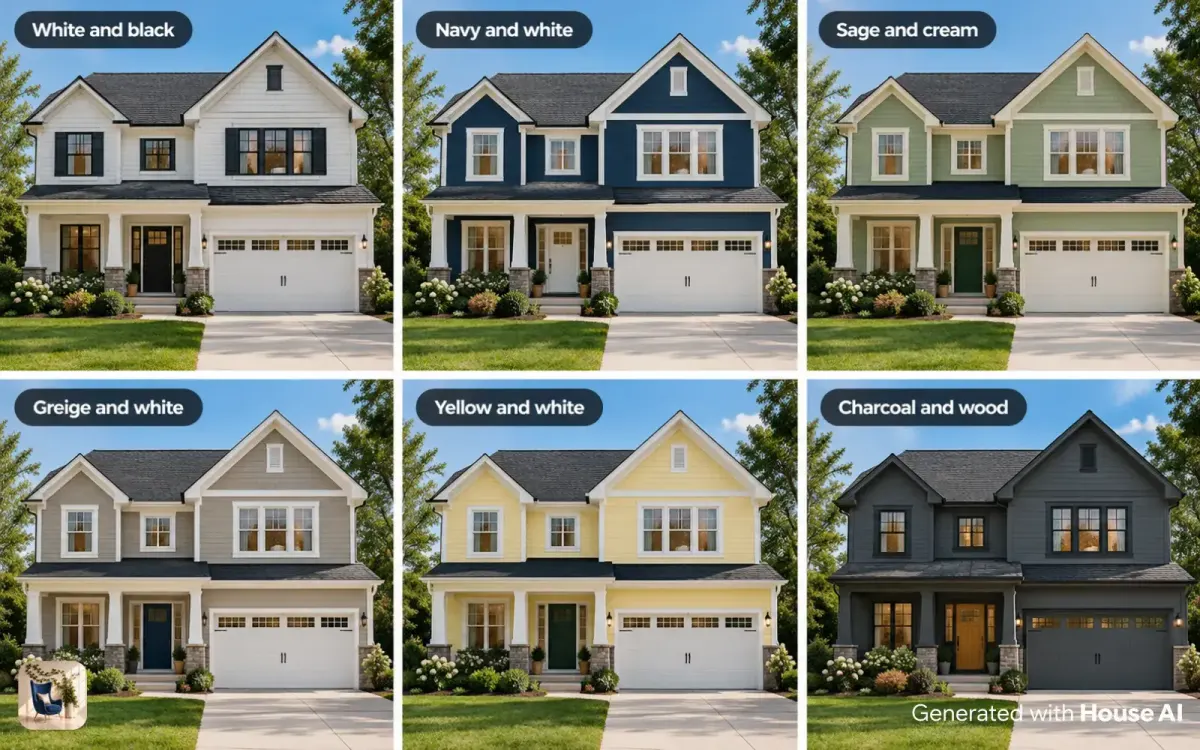
The best exterior house paint colors match the house style: white with black accents on a colonial or modern farmhouse, sage or green with cream trim on a craftsman, soft gray or greige on a ranch, and warm white on Mediterranean stucco. Use a body, a trim, and one accent color. House AI's exterior design tool shows a scheme on your house photo in about 15 seconds.
Paint chips are tiny and the front of a house is huge, so colors that look calm on a card can look loud on siding. This guide pairs color schemes with house styles and names real paint colors from the maker's own pages. Every render on this page started as a photo of the same real house front.
How to build an exterior color scheme
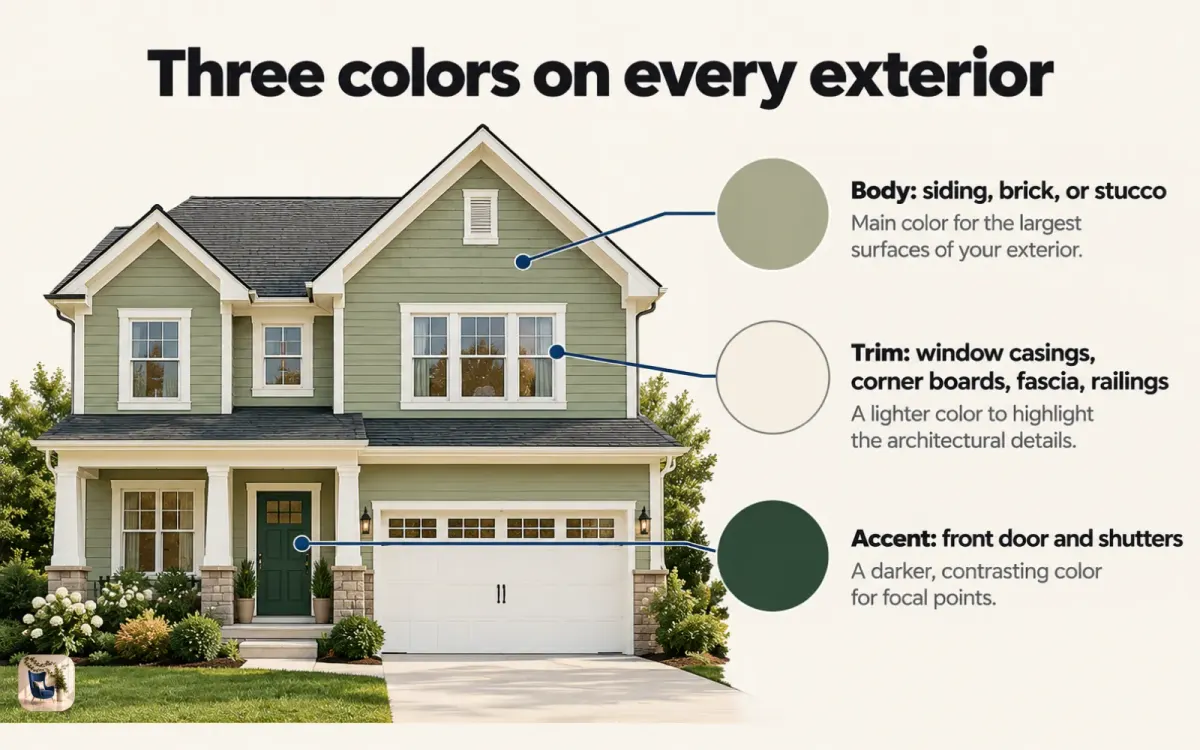
Most good exteriors use three colors: one for the body, one for the trim, and one accent. The body is the siding, brick, or stucco, and it covers most of what people see. The trim is the window casings, corner boards, fascia, and porch railings. The accent goes on the front door and sometimes the shutters.
Start with what you can't change. The roof, any brick or stone, the driveway, and the window frames all have their own color, and the paint has to get along with them. A brown roof pulls toward warm whites, creams, greens, and browns. A gray or black roof works with cooler grays, blues, and crisp whites. Once the fixed colors are on your list, choose the body color, then a trim that is clearly lighter or darker, then an accent that stands apart from both.
Color combinations by house style
The style of the house narrows the choices fast. These pairings follow the colors each style is known for. Every color named here is a Benjamin Moore color that the company lists for exterior use.
| House style | Body | Trim | Front door or accent |
|---|---|---|---|
| Colonial | White Dove OC-17 | White Dove OC-17 with Wrought Iron 2124-10 shutters | Caliente AF-290 red |
| Craftsman | Saybrook Sage HC-114 | Swiss Coffee OC-45 | Tarrytown Green HC-134 or stained wood |
| Ranch | Revere Pewter HC-172 | White Dove OC-17 | Hale Navy HC-154 |
| Modern farmhouse | White Dove OC-17 | Wrought Iron 2124-10 | Natural wood |
| Cape Cod | Boothbay Gray HC-165 | White Dove OC-17 | Hale Navy HC-154 |
| Victorian | Hawthorne Yellow HC-4 | White Dove OC-17 | Tarrytown Green HC-134 |
| Mid-century modern | Kendall Charcoal HC-166 | Kendall Charcoal HC-166 | Hawthorne Yellow HC-4 |
| Mediterranean or Spanish | Swiss Coffee OC-45 | Silhouette AF-655 | Wrought Iron 2124-10 ironwork |
| Contemporary | Silhouette AF-655 | Silhouette AF-655 | Natural wood |
A colonial reads best with high contrast, so the white body and near-black shutters do the work and a red door adds the one bright note. Craftsman homes lean on natural wood and earthy colors, which is why sage, green, and cream feel right on them. Ranch houses are long and low, and a soft greige body with white trim keeps them from looking flat without making them look busy.
Victorian houses are the exception to the three-color rule. Their trim is part of the design, so you can pick out the brackets and spindles in a second accent. Mid-century and contemporary houses go the other way. They can skip contrast trim entirely, paint the body and trim one dark color, and let wood, glass, and a bright door carry the design.
Light or dark: what light reflectance value tells you
Light reflectance value, or LRV, tells you how much light a paint color bounces back, from 0 for black to 100 for white. Benjamin Moore lists it on every color page. It is the most useful number on a paint chip for an exterior, because sunlight washes colors out and shade darkens them.
| Color | Code | LRV | Works best as |
|---|---|---|---|
| White Dove | OC-17 | 83.16 | Body or trim on almost any style |
| Swiss Coffee | OC-45 | 81.91 | Warm trim, or the body on stucco |
| Hawthorne Yellow | HC-4 | 71.33 | Body on a Victorian or a cottage |
| Revere Pewter | HC-172 | 55.05 | Body on a ranch or a split-level |
| Saybrook Sage | HC-114 | 45.46 | Body on a craftsman or a cottage |
| Boothbay Gray | HC-165 | 43.26 | Body on a Cape Cod or a shingle house |
| Kendall Charcoal | HC-166 | 14.61 | Body on a modern or mid-century house |
| Silhouette | AF-655 | 10.18 | Body on a contemporary house, or trim |
| Tarrytown Green | HC-134 | 9.71 | Front door or shutters |
| Caliente | AF-290 | 8.82 | Front door |
| Hale Navy | HC-154 | 8.36 | Front door, shutters, or a full body |
| Wrought Iron | 2124-10 | 8.17 | Shutters, window frames, and ironwork |
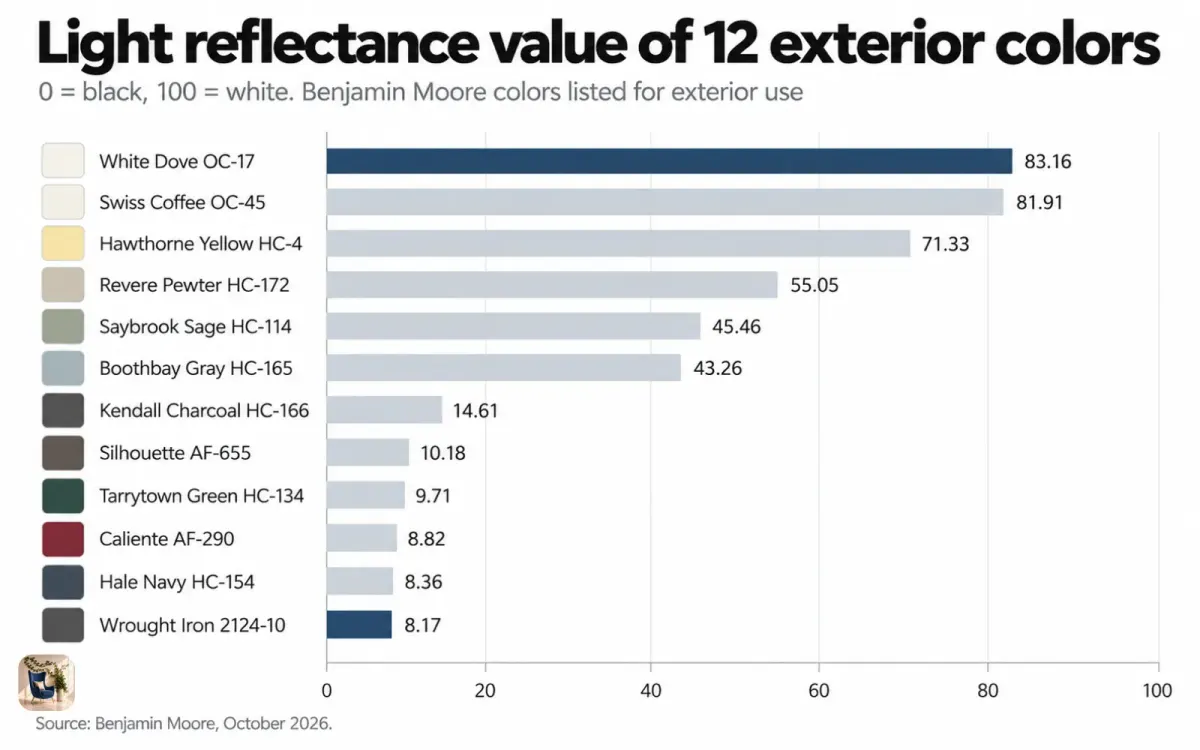
A light body with an LRV above 70 makes a house look bigger and brighter from the street. A body below 15 makes it look smaller and more solid, and it shows off wood and stone next to it. Dark colors also soak up more sunlight, so if your house has vinyl siding, check the siding maker's color guidance before you go very dark.
Front door and accent colors
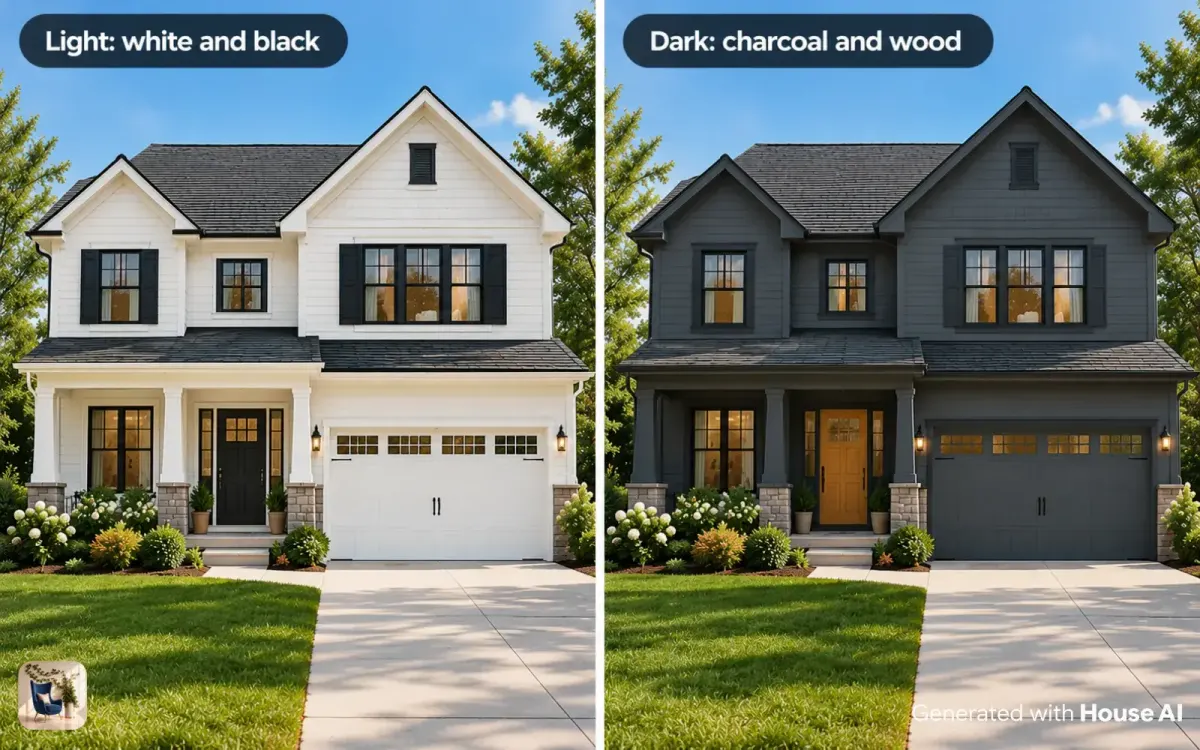
The front door is the cheapest place to take a risk, because it is one surface and you can repaint it in an afternoon. A red, deep green, or navy door works on a white or light gray house. On a dark house, try a warm wood door or a yellow door for contrast. Keep the shutters and the door in the same color family, or make the door the only bright color on the front.
Exterior colors that are hard to get right
Bright white, mid-tone gray, and saturated color are the three that surprise people most outside. Strong sun makes every color look lighter and brighter than the chip, so a stark white can glare and a bold blue can look almost electric. A safer move is to pick a color one step softer and one step grayer than the one you love on the card.
Gray is tricky for a different reason. Every gray leans warm or cool, and the lean grows on a big wall. A gray with a blue undertone can look icy next to a brown roof, and a warm gray can turn beige under a north-facing sky. Boothbay Gray, for example, is described by Benjamin Moore as a blue-gray, which suits a gray or black roof better than a brown one. Hold any gray sample next to the roof and the brick before you decide, and compare it with a plain white sheet of paper so you can see which way it leans.
How to test exterior colors on your own house
A scheme that looks good in a guide can fight with your roof or your brick. Test it on your house before you buy gallons.
Step 1: Photograph the front of the house
Stand across the street or at the end of the driveway on a bright, overcast day. Get the whole front, the roofline, and the front door in the frame, with no cars in the way.
Step 2: List the colors that stay
Write down the roof, brick, stone, and window frame colors. Every scheme you test has to work with them, so cross off anything that clashes before you start.
Step 3: Render three schemes in House AI
Open exterior design in House AI, upload the photo, and describe each scheme in your own words, for example "sage green siding, cream trim, dark green front door." Each design takes about 15 seconds on average, and every user gets 3 free designs a day with no credit card, enough for three schemes on one photo.
Step 4: Paint large samples on two sides
Pick your top two schemes and paint sample boards at least two feet square. Hold them against the siding on a sunny side and a shady side of the house, next to the trim and the roof.
Step 5: Look again at different times of day
Check the samples in the morning, at midday, and near sunset. If you have a homeowners association, get the colors approved before you paint.
What AI can't tell you about exterior paint
A render shows how a scheme feels on your house, but the color on a screen is not the color of the paint. Monitors and phone screens shift colors, and the AI does not match a render to a specific paint chip. It does not measure your siding either, and small details like trim boards and window grids can drift between the render and the real house. Use the render to pick a direction, then decide with real samples in daylight.
Design any room, shop or space with House AI in about 15 seconds. 1 free design a day.
Get Started TodayFrequently asked questions
What is the best exterior paint color for a house?
The best color depends on the house style and the colors you can't change, like the roof and brick. Warm white with black accents is the safest pick, since it suits colonial, farmhouse, and many newer homes.
Should exterior trim be lighter or darker than the body?
On most houses, trim is lighter than the body so the windows and edges stand out. On a modern or mid-century house, painting the trim the same dark color as the body gives a cleaner look.
How many colors should a house exterior have?
Three is the usual number: a body color, a trim color, and an accent for the front door. Victorian houses are the main exception, with two or more accent colors on their detailed trim.
What colors make a house look bigger?
Light colors with a high light reflectance value, like White Dove at 83.16, make a house look larger. Matching the trim to a light body makes it look larger still.
Can I see a paint color on my house before painting?
Yes. Upload a photo of your house to House AI's exterior design tool and describe the colors you want. Check the final pick with real paint samples, since screen color is not paint color.
Keep reading
- Curb Appeal Makeover: AI Exterior Design Tips
- Can AI Design My House Exterior From a Photo?
- AI Exterior Design
- Farmhouse Style
- Mediterranean Style
Sources: Benjamin Moore color pages for White Dove OC-17, Swiss Coffee OC-45, Hawthorne Yellow HC-4, Revere Pewter HC-172, Saybrook Sage HC-114, Boothbay Gray HC-165, Kendall Charcoal HC-166, Silhouette AF-655, Tarrytown Green HC-134, Caliente AF-290, Hale Navy HC-154, and Wrought Iron 2124-10, checked October 3, 2026. House AI figures come from the House AI app.