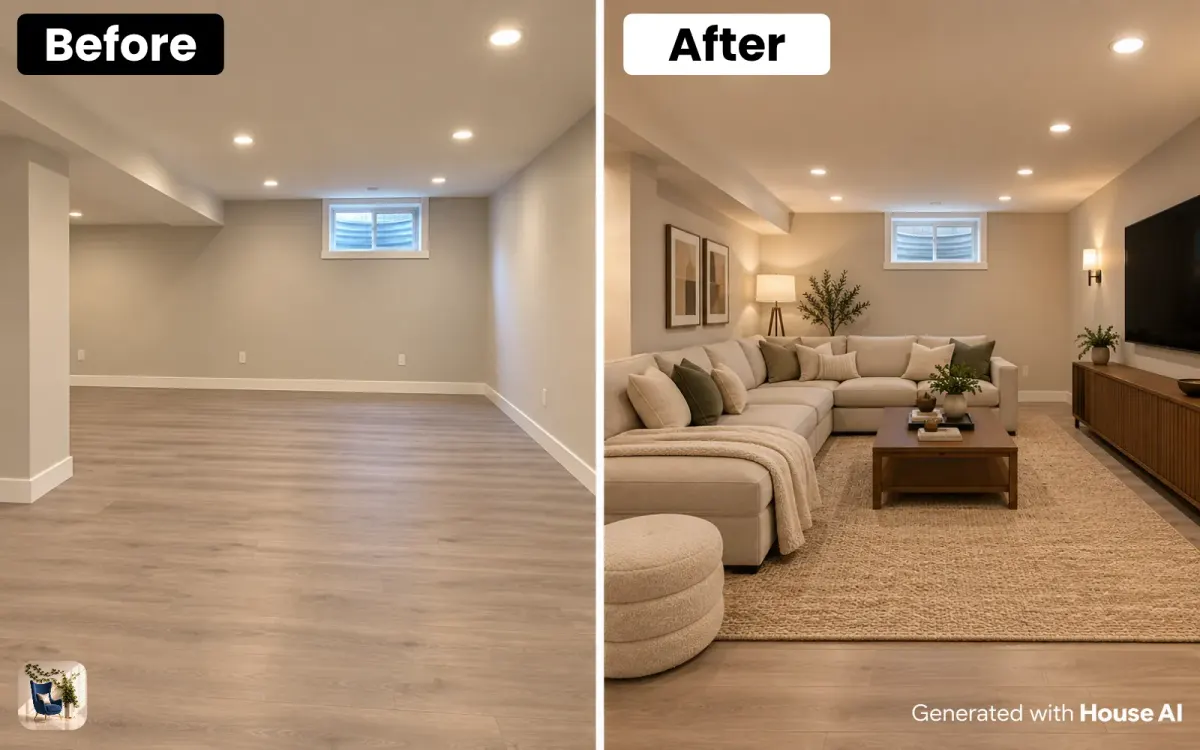
The best basement ideas turn the space into a family room, guest suite, home gym, bar, or kids play space. Before you choose, check three things: moisture, an emergency escape opening, and a ceiling of at least 7 feet. Angi puts the average basement remodel at $22,897. House AI can show ideas on a photo of your basement in about 15 seconds.
Finishing a basement adds living space inside walls, a floor, and a roof you already own. It is also the space with the most rules and the most surprises. This guide starts with the checks that decide what your basement can become, then walks through five ideas, what each one costs, and how to light a room with a low ceiling.
What to check before you finish a basement
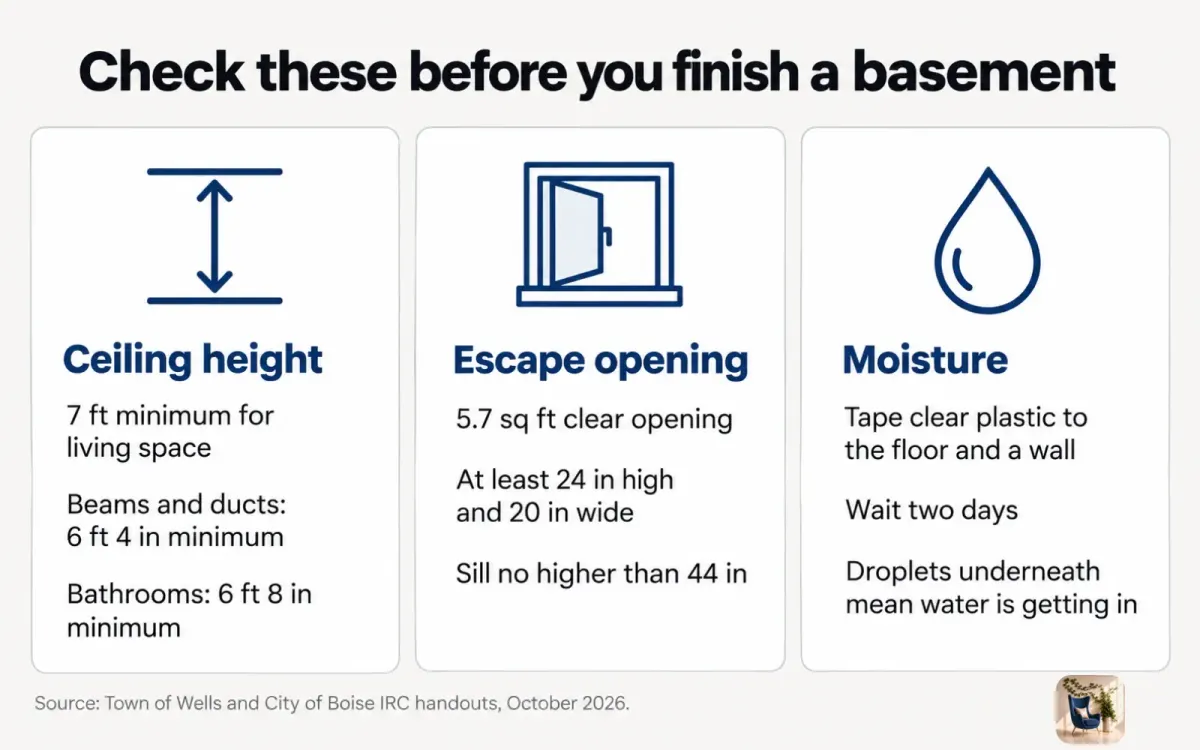
Check moisture, the escape opening, and the ceiling height before you spend anything on finishes. Each one can rule out an idea or add thousands to the budget, and none of them is easy to fix once the drywall is up.
Moisture comes first. Look for white mineral stains on the walls, a musty smell, peeling paint, or water marks on the floor after a heavy rain. A simple test is to tape a square of clear plastic to the floor and to a wall, leave it for two days, and see whether droplets form underneath. If water is getting in, fix the source before anything else. Angi puts basement waterproofing at $5 to $10 per square foot, and HomeGuide puts a full system with wall sealing, a pump, and a drain at $6,000 to $18,000 on average.
The escape opening comes next. The International Residential Code (IRC), section R310, requires an emergency escape and rescue opening in basements and in every sleeping room. Under the 2021 IRC, the opening needs at least 5.7 square feet of clear space, at least 24 inches of clear height and 20 inches of clear width, and a sill no more than 44 inches above the floor. The code also sets a size for the window well outside: at least 9 square feet, at least 36 inches out from the wall, and a ladder or steps if it is deeper than 44 inches. Angi puts an egress window at $2,700 to $5,900 installed, and HomeGuide at $2,000 to $5,000.
Ceiling height is the last check. IRC section R305 sets 7 feet as the minimum for habitable space in a basement, and the 2021 code lets beams, ducts, and other obstructions drop to 6 feet 4 inches. Bathrooms can be 6 feet 8 inches. Measure from the floor to the lowest joist, duct, and pipe, since the open middle of the ceiling is always the tallest point. Your city may have adopted a different edition of the code or added its own changes, so call the local building department before you draw up plans.
Basement ideas compared
Each idea asks different things of the space, so compare them before you fall for one. Angi prices the whole remodel at $30 to $75 per square foot on average, with most homeowners paying $12,031 to $34,649. HomeGuide puts finishing at $30 to $50 per square foot, or $15,000 to $75,000 for a 500 to 1,500 square foot basement.
| Idea | Cost from Angi | What it needs | Watch for |
|---|---|---|---|
| Family room | Part of the general finish at $30 to $75 per square foot | Flooring, drywall, outlets for a TV, and layered light | Hard floors echo, so plan a large rug |
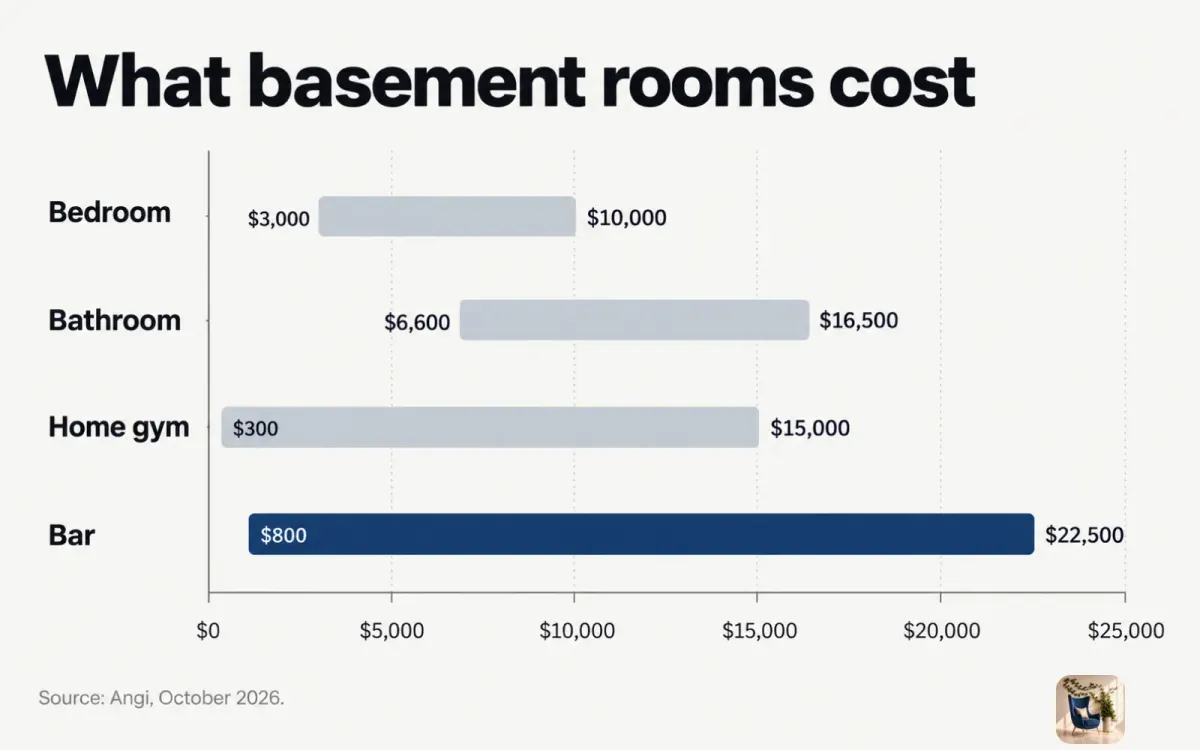
| Guest suite | $3,000 to $10,000 for the bedroom, plus $6,600 to $16,500 for a bathroom | An escape opening in the bedroom, heat, and a closet | The IRC requires an escape opening in every sleeping room |
| Home gym | $300 to $15,000 | Rubber flooring, fresh air, and clearance for overhead lifts | Beams and ducts can be lower than the ceiling around them |
| Bar | $800 to $22,500 | Outlets for a fridge, and a water line and drain for a wet bar | Plumbing sets the bar's location, so plan it early |
| Kids play space | Part of the general finish at $30 to $75 per square foot | Soft, washable flooring, low storage, and covered outlets | Keep it close to the stairs and away from the mechanical room |
Family room and media space
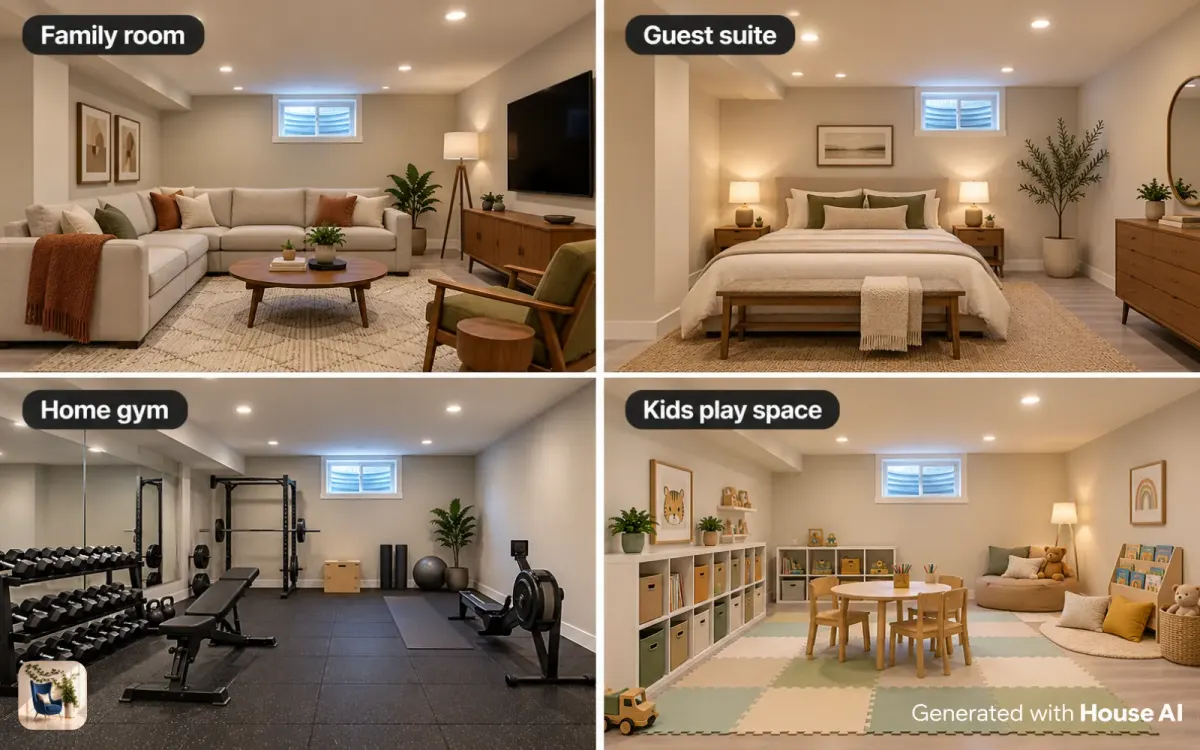
A family room is the easiest basement idea to pull off, because it needs no plumbing and no bedroom rules. Put the TV on the wall with no windows, since basement windows sit high and cause glare on a screen. A deep sectional and a large rug soften the hard surfaces, and they make the room sound quieter too.
Keep the furniture low and pushed toward the walls, which leaves the middle of the room clear and makes the ceiling feel higher. If the basement has a support post in the middle, build the seating around it instead of fighting it. A post can anchor the back of a sofa or hold a small shelf.
Guest suite
A guest suite needs the most planning, because the bedroom has to meet the escape opening rule. Place the bed wall away from the egress window so guests can reach the window easily. Angi puts a basement bedroom at $3,000 to $10,000, and HomeGuide puts it at $3,000 to $12,000.
A bathroom turns a spare bed into a real suite, and it usually costs more than the bedroom itself. Angi puts a basement bathroom addition at $6,600 to $16,500, while HomeGuide puts it at $10,000 to $25,000 depending on size. If your main sewer line sits above the basement floor, ask a plumber about the drain before you settle on a spot.
Home gym, bar, and kids play space
These three ideas work well in a basement because they make noise, need durable floors, or both. A home gym needs rubber flooring and good airflow. Measure your clearance for overhead presses and jump rope under the lowest beam, not the open ceiling. Angi puts a basement home gym anywhere from $300 to $15,000, depending on the equipment.
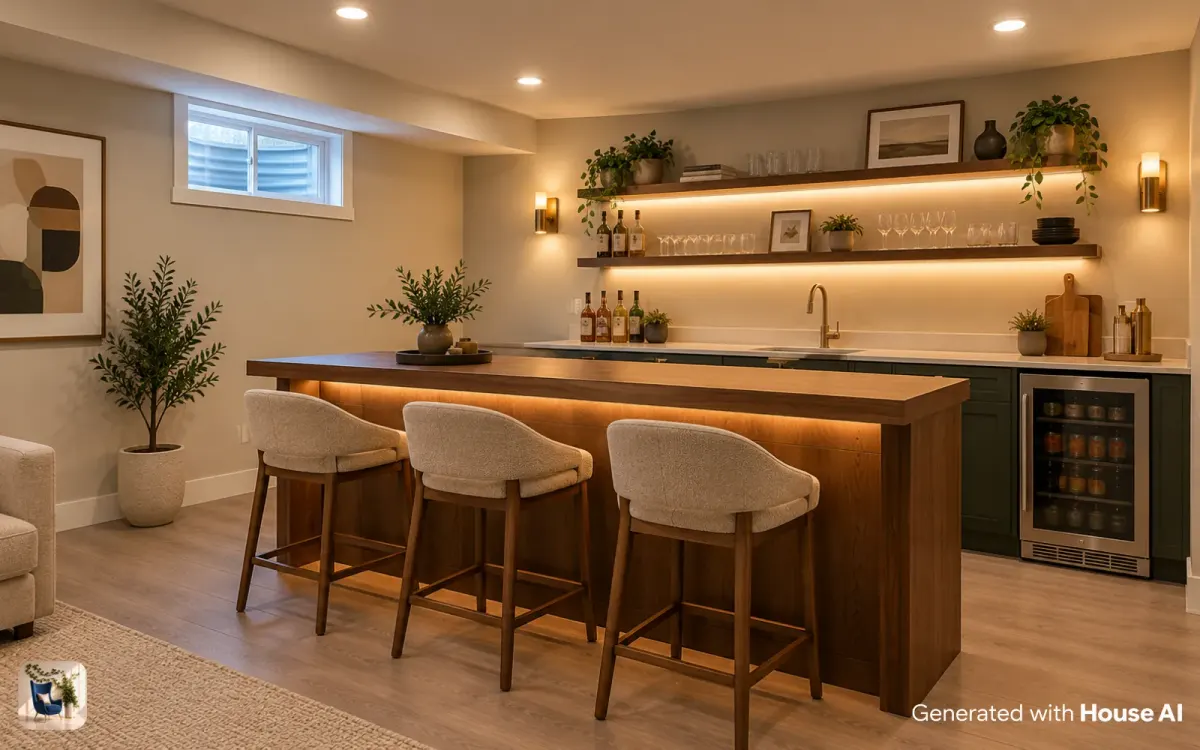
A bar can be as simple as a counter, a mini fridge, and open shelves, or as full as a wet bar with a sink and dishwasher. Angi puts a basement bar at $800 to $22,500. HomeGuide puts a wet bar at $2,000 to $30,000 installed.
A kids play space gives the main floor back to the adults. Choose washable paint, foam or carpet tile that can be swapped one square at a time, and storage low enough for small hands. Keep toys and play mats out of the room with the furnace and water heater.
Lighting ideas for a low basement ceiling
Use flat light sources that sit tight to the ceiling, and add light on the walls. Hanging pendants and chandeliers eat headroom, and they become something to duck around under a 7-foot ceiling. Slim recessed lights, often sold as wafer lights, need very little depth and spread light evenly. HomeGuide puts recessed lighting at $125 to $300 per light installed.
Wall sconces, floor lamps, and LED strips under shelves or a bar counter push light sideways and upward, which makes the ceiling read higher. Pick one color temperature for the whole room so the corners don't look patchy. Paint the ceiling a light, flat color to bounce that light back down.
The ceiling itself matters too. A drop ceiling hangs below the joists, so it costs you a few inches of height, but it keeps pipes and wires easy to reach. HomeGuide puts a drop ceiling at $4 to $20 per square foot and a drywall ceiling at $2 to $4 per square foot installed. In a tight basement, drywall usually keeps more headroom.
How to plan your basement with a photo
A photo of the space lets you compare ideas before you call a contractor. These steps take one afternoon.
Step 1: Measure the space and the ceiling
Measure the length and width of the basement, then the height to the lowest beam, duct, and pipe. Mark where the windows, stairs, posts, and mechanical equipment sit.
Step 2: Run the three basic checks
Do the plastic sheet moisture test, check whether you have a window that meets the escape opening rule, and compare your lowest height with the 7-foot minimum. Write down what fails, since it shapes the budget.
Step 3: Take one wide photo
Stand in a corner with every light on, so two walls, the floor, and the ceiling are in the frame. Clear boxes and loose clutter first so the shape of the room is easy to read.
Step 4: Try two or three ideas in House AI
Upload the photo to House AI and set the room type to living room for a family room, gym, bar, or play space, or to bedroom for a guest suite. Pick a style from the grid or describe the look in your own words. Each design takes about 15 seconds on average, and every user gets 3 free designs a day, so you can compare three ideas on one photo.
Step 5: Price the idea you keep coming back to
Take the design you like best and the cost ranges above to two or three contractors. Ask each one to price the moisture fix, the escape opening, and the finish as separate lines.
What AI can't tell you about a basement
An AI redesign shows how an idea could look in your basement. It can't see water behind the walls, it doesn't measure the ceiling height, and it can't tell you whether a window meets the escape opening rule. Small details can drift between the render and the finished room, so a sofa that fits the picture may not fit around the stairs. Use the render to pick a direction, then let a contractor and your building department confirm the rest.
Design any room, shop or space with House AI in about 15 seconds. 1 free design a day.
Get Started TodayFrequently asked questions
How much does it cost to finish a basement?
Angi puts the average basement remodel at $22,897, with most homeowners paying $12,031 to $34,649. That works out to $30 to $75 per square foot on average.
What is the minimum ceiling height for a finished basement?
Under the 2021 IRC, habitable space in a basement needs a ceiling of at least 7 feet, and beams, ducts, and other obstructions can drop to 6 feet 4 inches. Check with your local building department, since cities can amend the code.
Does a basement bedroom need an egress window?
Yes. The IRC requires an emergency escape and rescue opening in every sleeping room, with at least 5.7 square feet of clear opening and a sill no more than 44 inches above the floor.
What is the best lighting for a low basement ceiling?
Slim recessed lights that sit tight to the ceiling, plus wall sconces, floor lamps, and LED strips. Skip hanging pendants, which take up headroom.
Can I see basement ideas on a photo of my own basement?
Yes. Upload a photo to House AI and set the room type to living room or bedroom, then pick a style. Each design takes about 15 seconds on average, and the free tier gives you 3 designs a day.
Keep reading
- How to Choose the Perfect Lighting for Every Room
- How Do I Make a Room Feel Cozy?
- How Do I Make a Small Room Look Bigger?
- Interior Design on a Budget: Where to Spend and Where to Save
- Free AI Interior Design
Sources: Angi, "How Much Does a Basement Remodel Cost? [2026 Data]," updated September 23, 2026. HomeGuide, "How Much Does It Cost to Finish a Basement? (2026)," February 6, 2026. Town of Wells, Maine, "Answers to common questions on the 2021 IRC/IECC," undated. City of Boise, "IRC Code Section R305 Ceiling Height," handout 434, January 2022. International Code Council, "BCAC IRC 3-2/IBC 10-4 Emergency Escape and Rescue Openings," revised September 12, 2018. All checked October 17, 2026. House AI figures come from the House AI app.