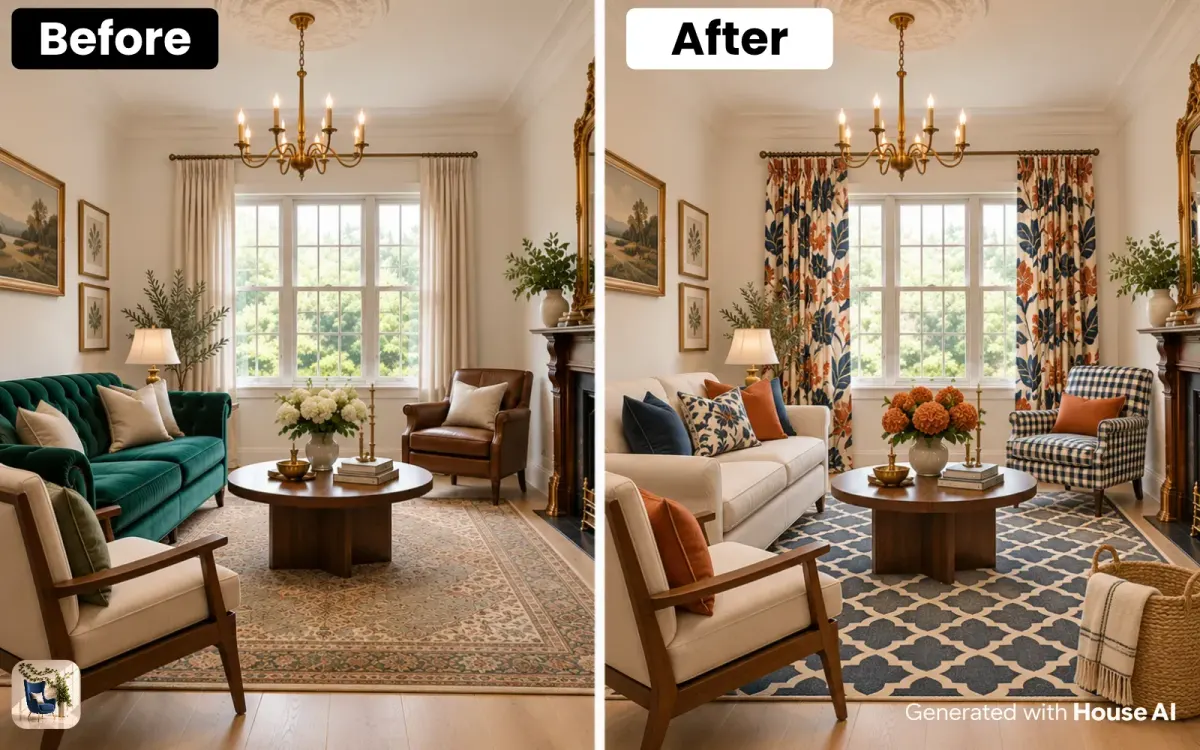
To mix patterns in a room, pick one large pattern, one medium, and one small, and make all three share at least one color. Give the eye places to rest with solid fabrics and plain textures, then spread the patterns around the room instead of grouping them in one corner. House AI can show a pattern mix on a photo of your room in about 15 seconds.
Most pattern advice stops at one sofa or one bed. A room is harder, because the rug, the curtains, the upholstery, the wallpaper, and even the tile all count. This guide works at the scale of the whole room, so you can plan the mix before you buy a single yard of fabric.
Why patterns clash in a room
Patterns clash for three reasons: they compete at the same size, they fight over color, or they all sit in one spot. Two big florals of the same scale pull your eye back and forth with nowhere to land. A bright primary print next to a dusty pastel looks like two rooms glued together. A patterned rug, patterned chair, and patterned curtain stacked in one corner make that side feel heavy while the rest of the room looks bare.
Fix those three things and give the eye somewhere to rest. After that, almost any set of patterns can live together.
Vary the scale: one large, one medium, one small
The simplest rule is to use patterns at three different sizes. HGTV's guide to mixing patterns calls three the minimum and suggests the second pattern be about half the scale of the first. The large pattern sets the mood, the medium one supports it, and the small one adds detail up close.
Scale here means how big the repeat looks from across the room, not how big the piece of furniture is. A wide stripe reads as large on a curtain and on a throw. A tiny dot reads as small almost anywhere. Stand at the doorway when you judge it, because that is where most people first see the room.
| Pattern type | Usual scale | Mood | Good places for it | Pairs well with |
|---|---|---|---|---|
| Large florals and botanicals | Large | Soft, lively | Curtains, wallpaper, one accent chair | Small checks, thin stripes, solids |
| Large geometrics and trellis | Large or medium | Graphic, ordered | Rugs, wallpaper, headboards | Florals, small dots, textured solids |
| Stripes | Any, set by stripe width | Crisp, calm | Upholstery, rugs, bedding, walls | Florals, paisley, plaid |
| Plaid and check | Medium or small | Cozy, classic | Throws, chair seats, bedding | Florals, stripes, damask |
| Ikat and kilim | Medium | Warm, global | Rugs, ottomans, cushions | Solids, stripes, woven textures |
| Damask and paisley | Medium | Formal, traditional | Drapes, upholstery, wallpaper | Plaid, stripes, small checks |
| Small dots and tiny prints | Small | Light, playful | Lampshades, bedding, small chairs | Large florals, large geometrics |
| Texture (boucle, linen, jute, wood grain) | Reads as a quiet pattern | Restful | Sofas, rugs, baskets, floors | Every pattern above |
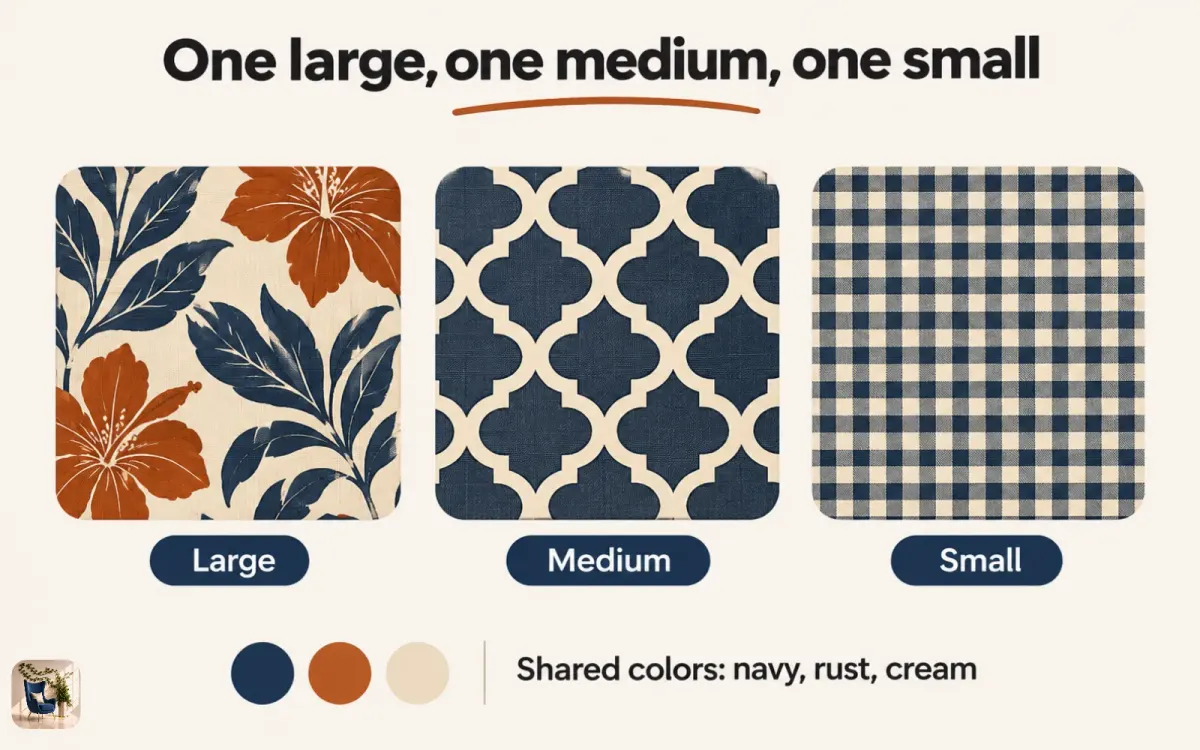
Keep a shared color thread
Patterns get along when they share at least one color. Pick a palette of three or four colors before you shop, then make sure every pattern in the room carries at least one of them. The patterns do not need to match each other. They only need to overlap.
Color intensity matters as much as hue. HGTV warns against mixing pastels with primaries or muted tones with bright jewel tones, and it suggests sticking to one family of white, whether that is cream, off-white, or bright white. A navy that is slightly gray will look dull next to a saturated cobalt, even though both are blue.
A good trick is to let the biggest pattern pick the palette. If your large-scale curtain has navy, rust, and cream in it, those three colors become the rules for the rug, the chair, and everything else.
Balance busy and quiet surfaces
Every busy surface needs a quiet one nearby. Solid fabrics, plain walls, and natural textures give the eye a place to rest between patterns, and they make each pattern easier to see. A patterned rug looks richer under a solid sofa than under a patterned one.
Texture helps here too. A nubby boucle chair, a linen curtain, a jute rug, or a wood floor with a strong grain all add interest without adding another print. They count as quiet surfaces, so you can use plenty of them.
Big surfaces are the place to be careful. The sofa, the bed, the largest rug, and the walls take up most of what you see, so give at least two of them a solid color or a quiet texture. Pillows are the easiest place to test a mix, since they are small and move easily.
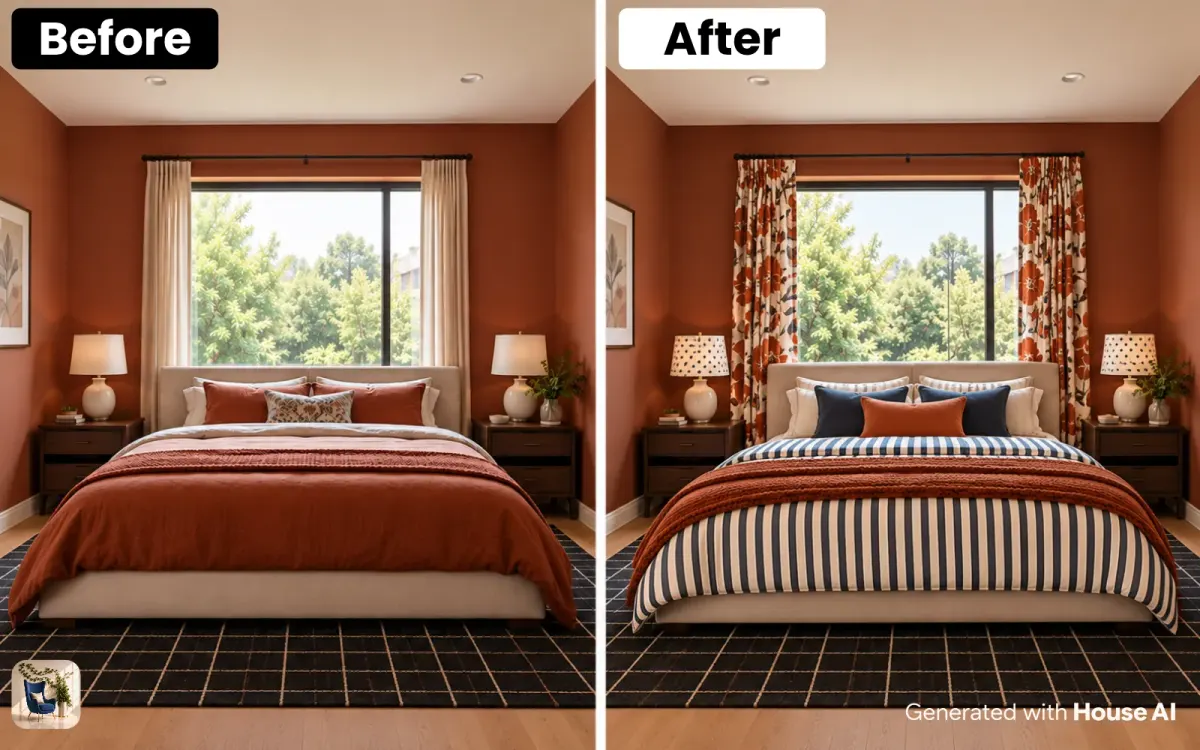
Spread patterns around the room
Place patterns so they appear on more than one side of the room. HGTV's advice is to avoid clustering all the patterned pieces on one side. A simple way to do it is to think in a triangle: the large pattern on one wall, the medium pattern across the room, and the small pattern somewhere between them.
Count the patterns you already have before you add any. A brick fireplace, a tiled floor, a herringbone wood floor, and a bookcase full of spines all read as pattern. If one wall already has a busy tile backsplash or a stone surround, let that be your large pattern and build the rest around it.
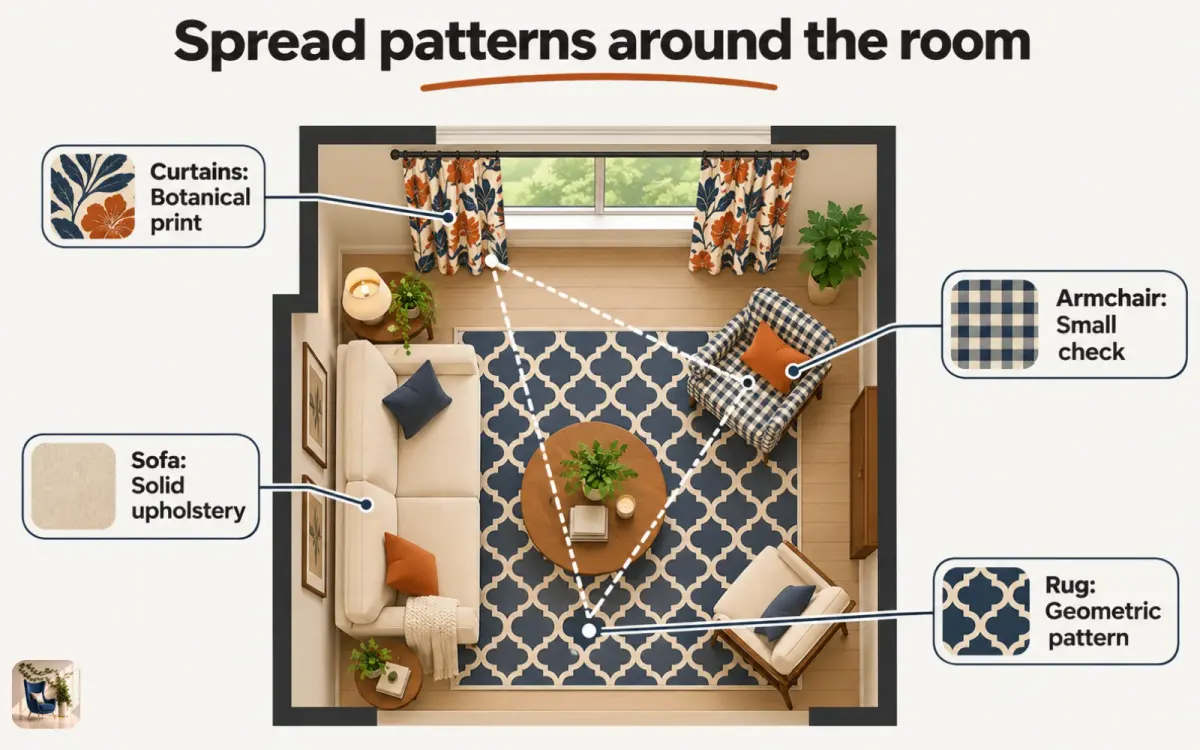
How to mix patterns in a room, step by step
Use these steps on one room at a time. They work for a living room or a bedroom, and they work whether you are starting from scratch or adding to what you have.
Step 1: Count the patterns already in the room
Walk the room and list every pattern you see, including floors, tile, brick, and wallpaper. Note which ones you can't change, because those set the starting point.
Step 2: Choose your large-scale anchor
Pick the one pattern you love most and give it a big surface, such as curtains, a rug, or an accent wall. This pattern sets the palette and the mood for the room.
Step 3: Pull three or four colors from it
Choose the main color and two or three supporting colors from the anchor. Every other pattern in the room must use at least one of them, at a similar strength.
Step 4: Add a medium pattern and a small one
Add a medium pattern with a different shape, such as a stripe or a geometric if the anchor is a floral. Then add a small pattern, like a check or a tiny dot, for detail you notice up close.
Step 5: Rest the eye with solids and texture
Put solid colors or plain textures on at least two of the biggest surfaces, usually the sofa or bed and the walls. Use linen, wool, jute, and wood to keep those quiet surfaces from feeling flat.
Step 6: Spread the patterns and step back
Place the three patterns on different sides of the room, then look from the doorway. If one side feels heavy, move a patterned piece across the room or swap it for a solid.
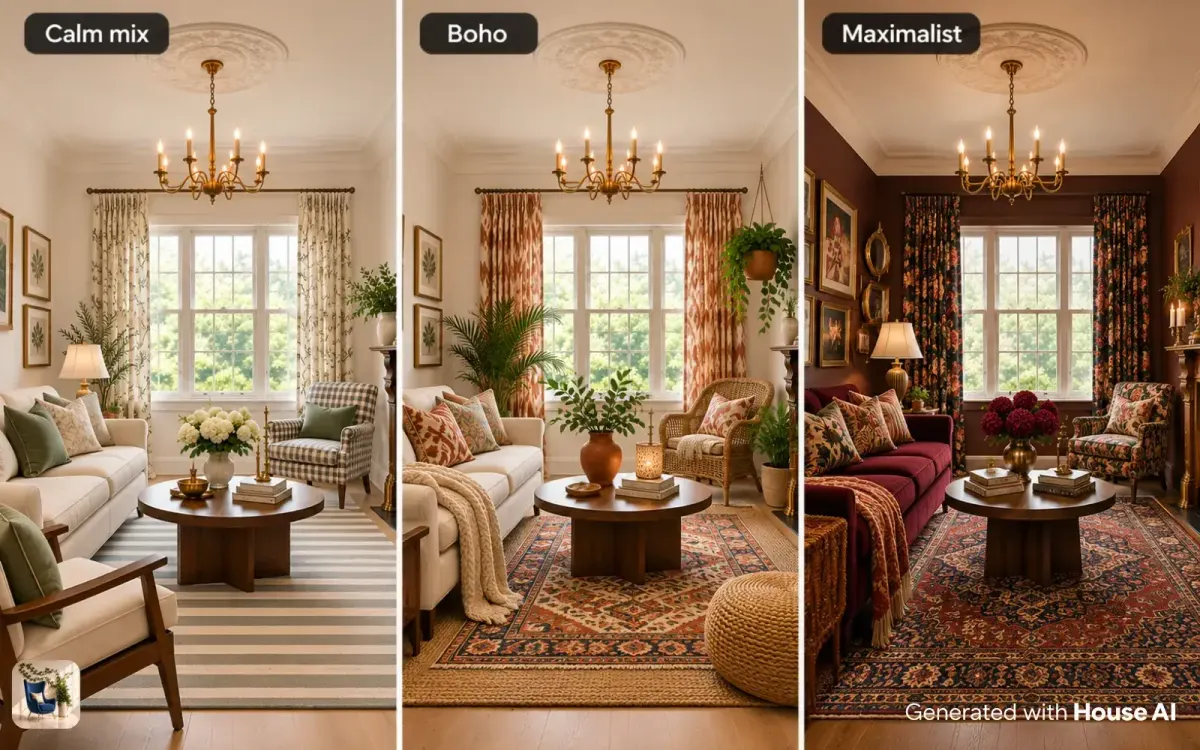
When to go bolder with pattern
Go bolder once the three basics are in place: varied scale, a shared color, and patterns spread around the room. Those rules still hold in the busiest rooms. Maximalist rooms layer pattern on pattern, from wallpaper to rugs, and they stay together by repeating a small set of deep colors. Boho rooms mix kilim, ikat, and florals in warm earth tones, with rattan and plants doing the resting.
If you want more pattern, add it one layer at a time and keep the palette fixed. A fourth or fifth pattern is easier to add when it repeats a color you already use. When a bold room starts to look messy, take away a color before you take away a pattern.
What AI can and can't show you about a pattern mix
An AI redesign shows how a pattern mix feels in your actual room, with your windows, your floor, and your light. That makes it a quick way to compare a calm mix with a bolder one before you order fabric. Upload a photo to House AI, set the room type, and pick a style from the grid or describe the look in your own words. Every user gets 3 free designs a day.
It has limits. AI doesn't measure your room, so it can't tell you how many yards of fabric or rolls of wallpaper you need. Small details like the exact repeat of a print can drift in a render, and screen color is not fabric color. Order swatches, tape them up where they will go, and look at them in daylight and at night.
Design any room, shop or space with House AI in about 15 seconds. 1 free design a day.
Get Started TodayFrequently asked questions
How many patterns can you use in one room?
Start with three, at large, medium, and small scale. HGTV calls three the minimum for a mixed look, and you can add more if each new one shares a color with the others.
What is the rule for mixing patterns?
Vary the scale, share at least one color, balance patterns with solids and texture, and spread them around the room. Those four rules cover most rooms.
Can you mix stripes and florals?
Yes. Stripes and florals are one of the easiest pairs because their shapes are so different. Keep them at different scales and give them a shared color.
Do patterns in a room have to match?
No. Patterns only need to share a color or two and differ in scale. Matching sets often look flatter than a mix that overlaps on color.
Can I see a pattern mix on my room before I buy?
Yes. Upload a photo of your room to House AI and try a style or describe the pattern mix you want. Each design takes about 15 seconds on average.
Keep reading
- What Is Maximalist Interior Design?
- What Is Boho Interior Design?
- How Do I Mix Wood Tones in a Room?
- Interior Design Styles Explained: 40 Looks With Real Room Examples
Sources: HGTV, "Mix Patterns Like a Pro," Anne Krueger, November 25, 2014, checked October 17, 2026. House AI figures come from the House AI app.