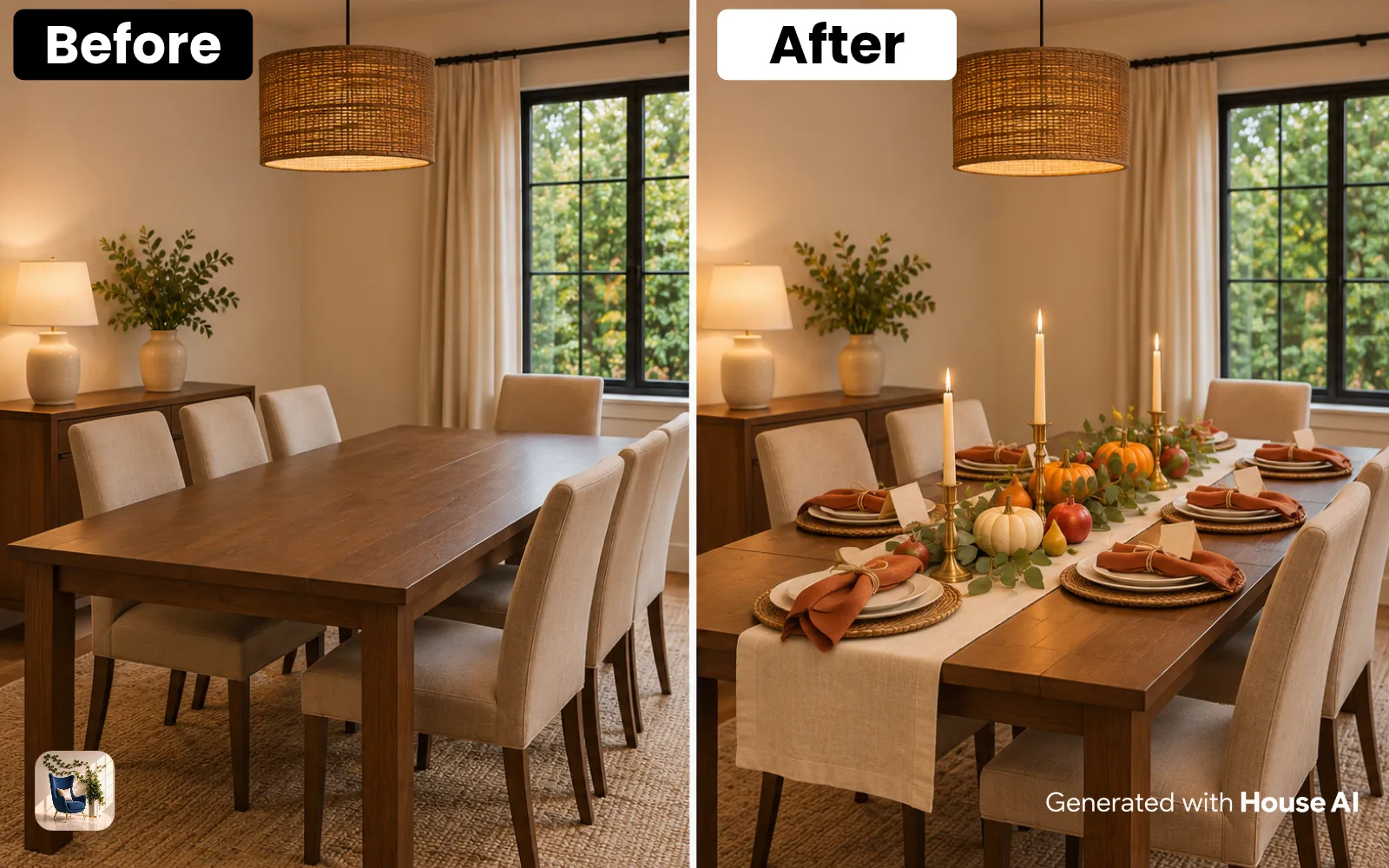
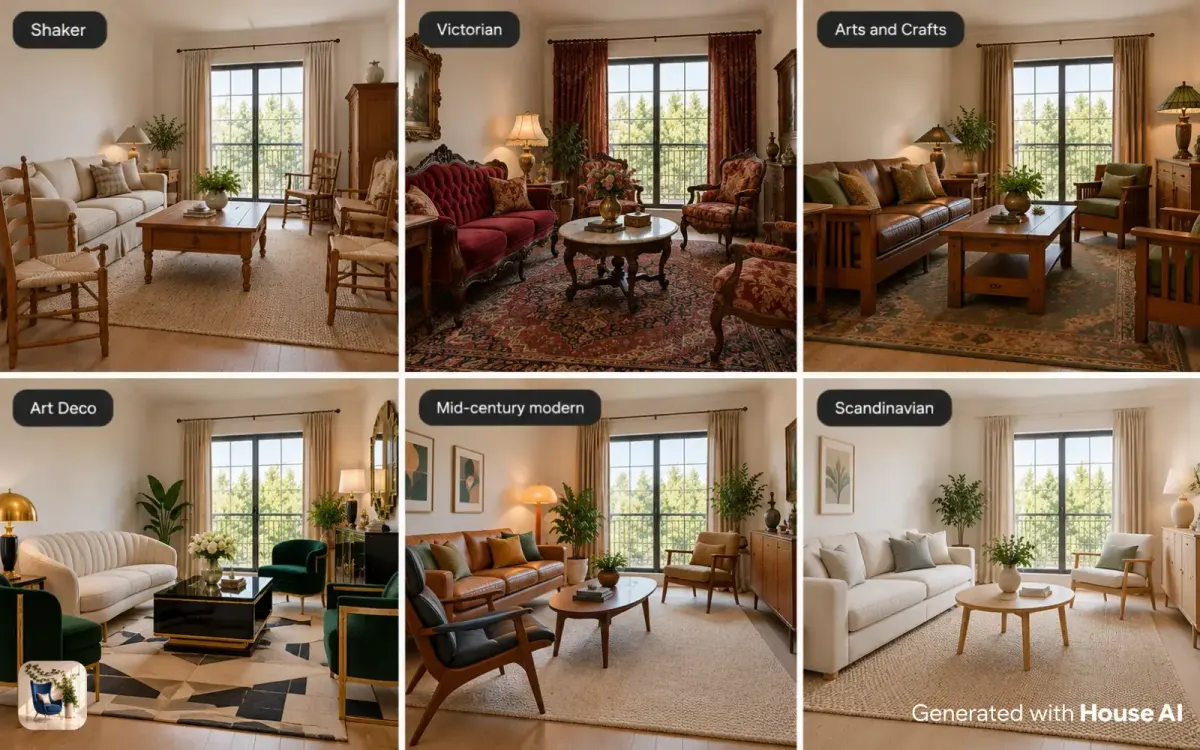
A furniture style is a named period look you can spot by its legs, arms, wood, and ornament. The main ones run from Queen Anne (1702 to 1714) and Chippendale through Shaker, Victorian, and Arts and Crafts to Art Deco, mid-century modern, Scandinavian, and contemporary. You can see several of them on a photo of your own room in House AI, which has 300+ styles.
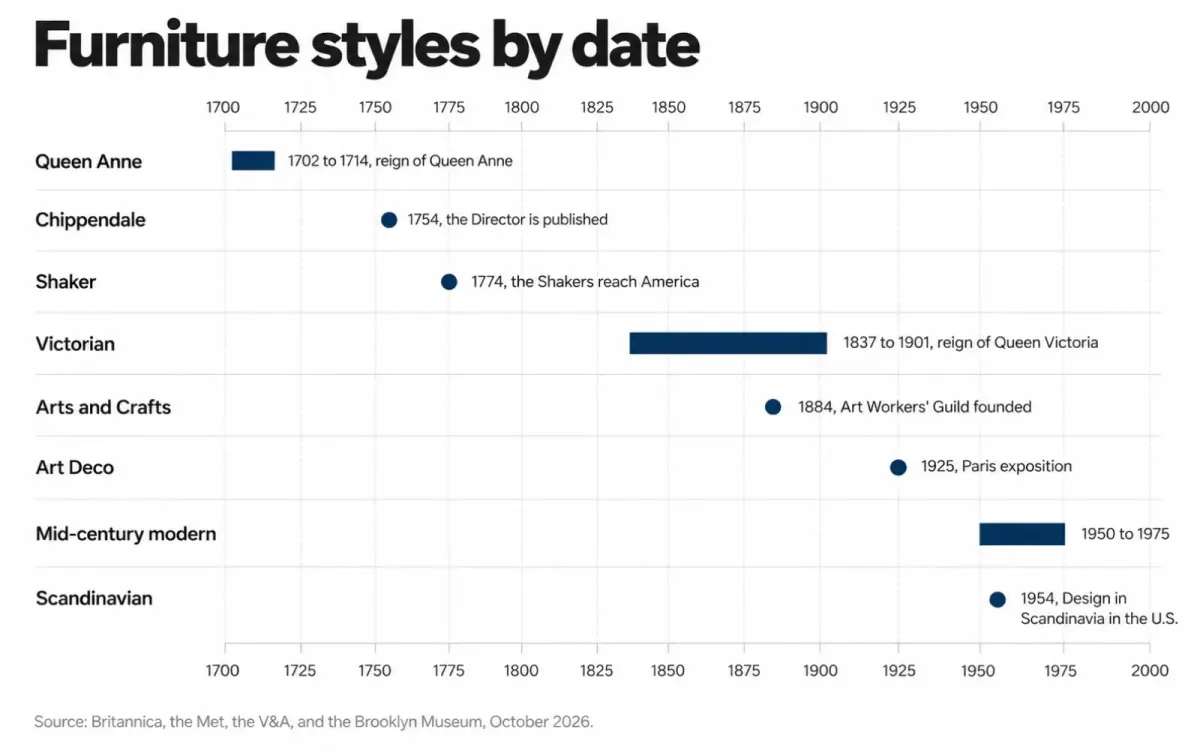
Furniture styles are more specific than room styles. A Chippendale chair belongs to a book published in 1754, and a Shaker chair belongs to a religious community. This guide puts nine of them in date order and shows you what to look at first.
How to identify a furniture style
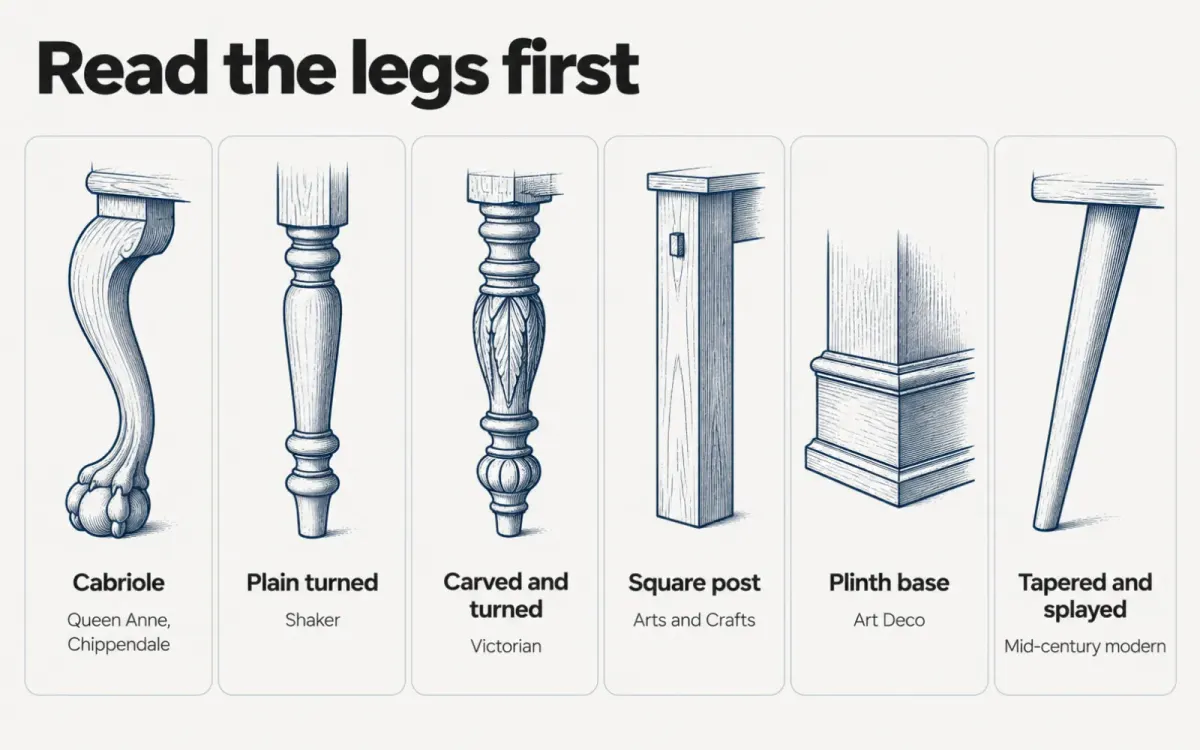
Start with the legs, because they change more between periods than anything else. A curved cabriole leg points to the 18th century. A thick square post points to Arts and Crafts. A slim tapered leg set at an angle points to the middle of the 20th century.
Then look at the arms and the back of a chair, the wood and how it is finished, and the ornament. Carving, inlay, and veneer were normal in some periods and refused in others. The Shakers, for example, avoided veneers, inlays, and carving altogether, according to the Metropolitan Museum of Art. Joinery is the last clue. Some makers hid it, and the Arts and Crafts makers put it on display.
Furniture styles by period at a glance
Use this table to put a name to a piece. The dates come from Britannica, the Met, and the V&A, and the last three columns are the clues to check.
| Style | Period | Legs and feet | Wood | Ornament |
|---|---|---|---|---|
| Queen Anne | 1702 to 1714, the reign of Queen Anne (Britannica) | Cabriole legs ending in a claw-and-ball or paw foot | Walnut | Scallop shells, scrolls, animals, and plants |
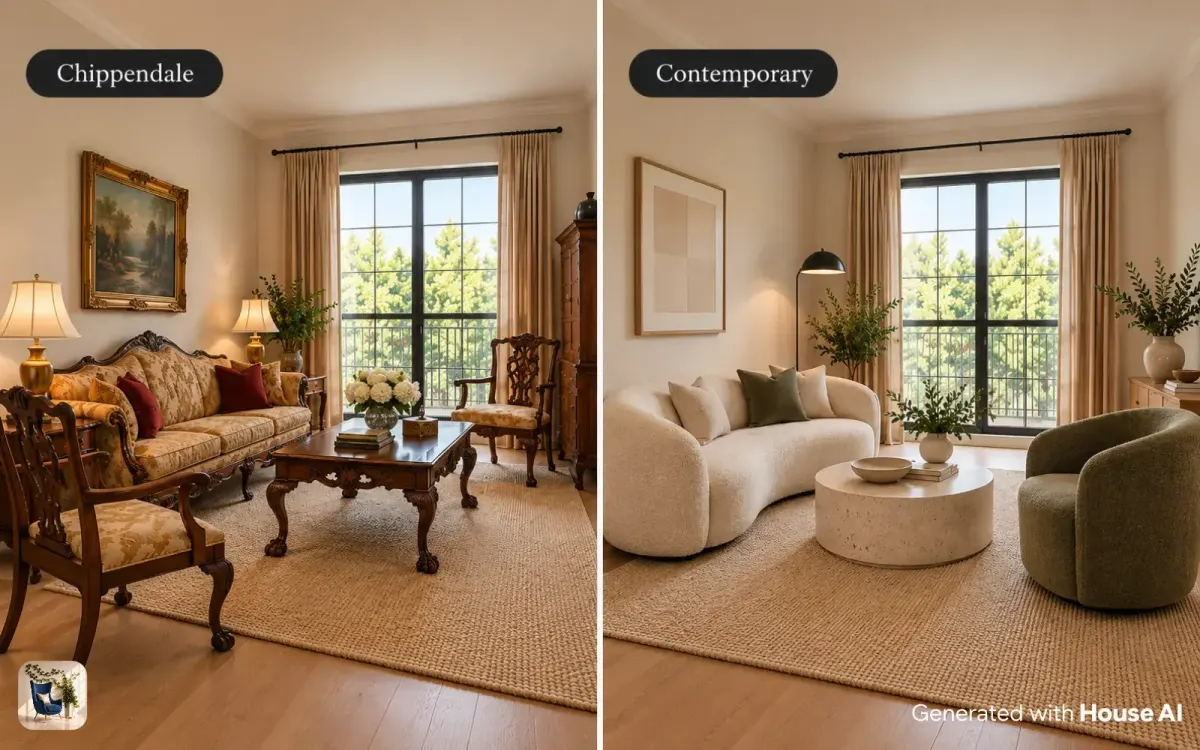
| Chippendale | Third quarter of the 18th century; the Director pattern book came out in 1754 | Cabriole legs with claw-and-ball feet, or straight square legs | Mahogany | Rococo, Gothic, and Chinese motifs, including fretwork |
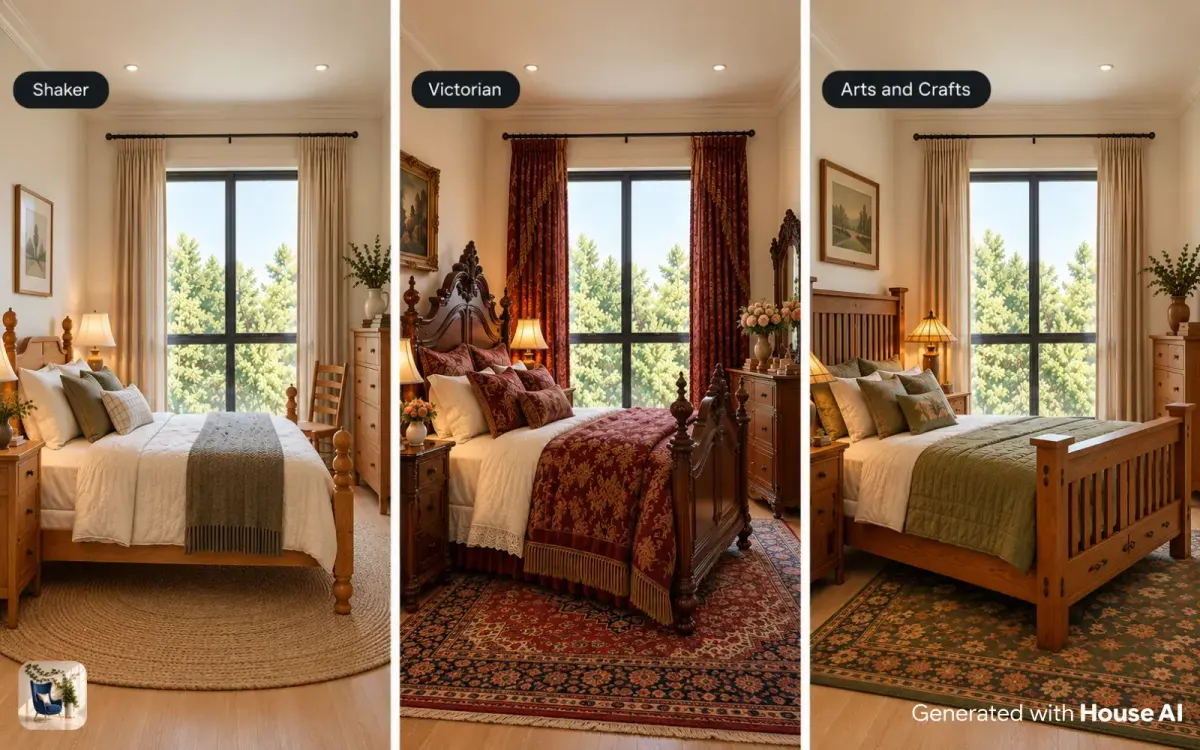
| Shaker | Shakers reached America in 1774; their peak was the mid-19th century | Plain turned legs and posts | Pine, maple, and cherry, often painted or stained | None: no veneer, inlay, or carving |
| Victorian | 1837 to 1901, the reign of Queen Victoria (Britannica) | Carved and turned legs in revival styles | Rosewood and walnut | Heavy carving and matching silk upholstery |
| Arts and Crafts | Dominant in British homes by the close of the 19th century (V&A) | Thick square legs and posts | Oak, often local wood | Visible joints, exposed pins, and hand-hammered copper |
| Art Deco | 1920s and 1930s, peaking at the 1925 Paris exposition (Met) | Short, tapered, or solid plinth bases | Exotic wood veneers, later chromed steel | Geometric shapes and rich materials |
| Mid-century modern | About 1950 to 1975 (Met) | Slim tapered legs, often splayed | Molded plywood, walnut, and teak, with fiberglass and steel | Almost none; the shape is the decoration |
| Scandinavian | Modern Nordic design since the 1930s (Met) | Light, simple wood legs | Pale woods such as beech and birch | Very little; soft curves and woven seats |
| Contemporary | Today, so it keeps changing | Low, often hidden legs or solid bases | Mixed: wood, metal, stone, and performance fabric | Minimal, with rounded forms |
18th-century styles: Queen Anne and Chippendale
Queen Anne furniture is the first style most people learn to name, and the cabriole leg is the reason. Britannica dates the style's peak to the reign of Queen Anne, 1702 to 1714, and describes the cabriole leg as a double curve, swelling out at the top and curving in near the bottom. The leg ends in a claw-and-ball or paw foot. Britannica calls the period "the age of walnut," because walnut replaced oak in English furniture, and lists scallop shells, scrolls, animals, and plants as typical motifs.
Chippendale came next and took its name from a book. Thomas Chippendale's The Gentleman and Cabinet-Maker's Director was published in April 1754, followed by a second edition in 1755 and a third in 1762, according to the Met. Its title page sorted the designs into Gothic, Chinese, and Modern. Britannica places the style in the third quarter of the 18th century and pictures it with mahogany ribbonback chairs. If you see a pierced, carved chair back in dark red-brown wood, or Chinese fretwork, think Chippendale.
The quick way to tell them apart is ornament and wood. Queen Anne is quieter, in walnut, with smooth curves. Chippendale is busier, in mahogany, with more carving and a choice of three moods.
19th-century styles: Shaker, Victorian, and Arts and Crafts
Shaker furniture is the plainest of the old styles, on purpose. The Shakers first came to America from England in 1774 and were at their height in the mid-19th century, with more than 6,000 members, according to the Met. Their makers used local pine, maple, and cherry, usually painted or stained, and replaced brass drawer pulls with simple turned-wood knobs. Shaker chairs have turned posts, slat or ladder backs, and woven seats. By the 1860s, chairmaking was a staple industry of the community in New Lebanon, New York.
Victorian furniture went the other way. The period follows Queen Victoria's reign, 1837 to 1901, and in America it was an age of revival styles. The Met's essay on American revival styles from 1840 to 1876 names three: Rococo Revival for parlors, Gothic Revival for libraries, and Renaissance Revival for bedrooms and reception rooms. Look for elaborate carving, rosewood or walnut, and whole suites upholstered in matching silk.
Arts and Crafts started as a reaction against that, and London's Art Workers' Guild, set up in 1884, was part of it. The V&A says that by the close of the 19th century it had become the dominant style in British homes, and describes furniture with visible construction, simple structures, and limited decoration, down to exposed pins and dovetail joints. In America, Gustav Stickley built the same idea in oak. The Met's Stickley library table, made around 1906, has massive tenon-and-key joints and hand-hammered copper-headed nails holding its leather top.
20th-century styles: Art Deco, mid-century modern, and Scandinavian
Art Deco is the glamorous one. The Met says the style reached its height at the 1925 Exposition Internationale des Arts Décoratifs et Industriels Modernes in Paris. The V&A points to exotic wood veneers in the 1920s work of Émile-Jacques Ruhlmann, and to chromed steel, aluminum, mirror, colored glass, and new plastics in the 1930s. Shapes are geometric, finishes are rich, and legs are often short or replaced by a solid base.
Mid-century modern grew out of new materials. During the Second World War, Charles and Ray Eames developed molded plywood for Navy leg splints, and their later LCW chair was an inexpensive, mass-produced molded plywood object, according to the Met. The Met's survey of design from 1950 to 1975 names Eero Saarinen and Harry Bertoia shaping synthetic materials into organic forms, and Arne Jacobsen's Egg Armchair of 1957. Slim tapered legs and low profiles are the giveaway.
Scandinavian furniture overlaps with mid-century modern but runs lighter and warmer. The Met says Scandinavia had been making modernism a household word since the 1930s, and that many buyers who found strict modernism too demanding turned to its wood-based designs. In 1954 the touring show Design in Scandinavia brought more than 700 home furnishings from Denmark, Finland, Norway, and Sweden to the Brooklyn Museum. Pale wood, simple legs, and woven seats are typical.
Contemporary furniture and reproductions
Contemporary means furniture made in the style of right now, so it keeps changing. Today that usually means low, rounded sofas, solid bases, mixed materials, and very little ornament. It is the only style on this list with no fixed date.
Most period furniture you can buy new is a reproduction or an adaptation. A sofa sold as Chippendale today may have cabriole legs and a camelback, but it was made last year. The clues in this guide still work, and they help you shop. If a listing calls something Queen Anne, check for the cabriole leg. If it says Shaker, check for plain turned legs and no carving.
Styles people mix up
| Pair | The difference |
|---|---|
| Queen Anne vs Chippendale | Queen Anne uses walnut and smooth curves; Chippendale uses mahogany with more carving and Gothic or Chinese details |
| Shaker vs Arts and Crafts | Both are plain; Shaker hides its effort in painted pine or maple, while Arts and Crafts shows off its joints in oak |
| Victorian vs Queen Anne | Both curve; Victorian adds heavy carving and full upholstery, while Queen Anne keeps its curves smooth with lighter decoration |
| Mid-century modern vs Scandinavian | Mid-century often uses walnut, plywood, and fiberglass; Scandinavian stays with pale wood and woven seats |
| Art Deco vs contemporary | Art Deco loves shine and geometric ornament; contemporary keeps rounded shapes with almost no ornament |
How to identify a piece you already own
You can date most pieces at home with a flashlight and a few minutes.
Step 1: Look at the legs and feet
Turn the piece on its side if you can. A cabriole leg with a claw-and-ball foot points to Queen Anne or Chippendale, a thick square post to Arts and Crafts, and a slim splayed leg to mid-century modern.
Step 2: Check the arms and the back
On a chair, look at the back first. A pierced, carved splat suggests Chippendale, horizontal slats suggest Shaker, and a molded plywood or fiberglass shell suggests the 1950s. Thick upholstered arms with carving lean Victorian, while thin wooden arms on a low chair lean mid-century.
Step 3: Identify the wood and finish
Walnut, mahogany, oak, and pale birch each point to different periods. Paint or stain over pine or maple is a Shaker habit, and exotic veneer suggests Art Deco.
Step 4: Read the ornament and joints
Note whether the piece has carving, inlay, or no decoration at all. Visible joints and copper nails are a sign of Arts and Crafts.
Step 5: Try the style in your room
Upload a photo of the room to House AI, pick a style from the grid such as Mid-Century or Scandinavian, or describe a period like Shaker in your own words. Each design takes about 15 seconds on average, and every user gets 3 free designs a day.
What AI can't tell you about a furniture style
A render shows how a furniture style looks in your room. It can't date a real antique, check the joints, or tell you whether a piece is original or a reproduction. It doesn't measure the room either, and small details like leg shapes and carving can drift between the render and real life. Use it to choose a period, then check the piece in person.
Design any room, shop or space with House AI in about 15 seconds. 1 free design a day.
Get Started TodayFrequently asked questions
What are the main furniture styles?
In date order: Queen Anne, Chippendale, Shaker, Victorian, Arts and Crafts, Art Deco, mid-century modern, Scandinavian, and contemporary.
How can you tell Queen Anne from Chippendale furniture?
Queen Anne pieces are usually walnut with smooth cabriole legs and less carving. Chippendale pieces are usually mahogany with more carving and Gothic or Chinese details.
What years is mid-century modern furniture?
The Met's survey of the period covers 1950 to 1975. The molded plywood that defines much of it came out of design work during the Second World War.
What is the oldest furniture style in this guide?
Queen Anne, which Britannica dates to the reign of Queen Anne, 1702 to 1714.
Can AI show my room with a different furniture style?
Yes. Upload a photo of your room to House AI and pick a style or describe one. The walls and windows stay in place while the furniture changes, in about 15 seconds.
Keep reading
- Interior Design Styles Explained: 40 Looks With Real Room Examples
- What Is Art Deco Interior Design?
- How Do I Mix Wood Tones in a Room?
- Mid-Century Modern Style
- Vintage Style
Sources: Britannica, "Queen Anne style," revised by Kathleen Kuiper, no date shown. Britannica, "Chippendale," no date shown. Britannica, "Victoria," last updated October 12, 2026. Femke Speelberg, "Thomas Chippendale's Gentleman and Cabinet-Maker's Director," the Met, May 2018. Nicholas C. Vincent, "Shaker Furniture," the Met, March 2012. Amelia Peck, "American Revival Styles, 1840 to 76," the Met, October 2004. V&A, "Arts and Crafts design for the home," last updated October 6, 2026. The Met, "Library Table," Gustav Stickley, about 1906. Alexandra Griffith Winton, "Design, 1925 to 50," the Met, October 2004. V&A, "Art Deco in the home," last updated April 17, 2024. The Met, "A Century of Design, Part III: 1950 to 1975," press release, November 2000. Brooklyn Museum, "Design in Scandinavia," exhibition, April 20 to May 16, 1954. All checked October 17, 2026. House AI figures come from the House AI app.