To find an interior designer near you, search ASID's Design Finder directory and ask people whose homes you like, then shortlist three to five names. Check NCIDQ status for free on the CIDQ site, review whole projects in each portfolio, interview your top picks, and get scope and fees in a written contract. House AI can render your room in 300+ styles first, so you arrive with a brief.
A search for "interior design near me" returns plenty of names and very little to judge them by. This guide assumes you've already decided to hire someone and covers the part that comes next: building a shortlist, checking credentials, asking the right questions, and reading the contract before you sign it.
Where to find interior designers near you
The best places to start are a professional directory and people you know. ASID, the American Society of Interior Designers, runs Design Finder, a directory of designers and firms that marks ASID practitioners with badges. It is a good way to see who works in your area. A listing is not a credential check, though, so treat it as a list of names to vet.
Referrals are often better. A friend or neighbor can show you a finished room in person and tell you how the project went, which no website can do. Real estate agents, contractors, and architects also know designers from real jobs. Each source has a blind spot, so most people end up mixing two or three of them.
| Where to look | What you get | What to watch for |
|---|---|---|
| ASID Design Finder | A directory of designers and firms, with badges for ASID practitioners | A listing is not proof of certification; verify it separately |
| Friends and neighbors | A finished room you can see and a past client you can question | Their taste and budget may not match yours |
| Furniture showrooms and design centers | Staff designers and names of local independents | Some showroom designers expect you to buy from that store |
| Contractors, architects, and real estate agents | Designers they have worked with on real projects | Staging a home to sell and designing one to live in are different skills |
| Instagram and portfolio sites | A fast read on a designer's style | Photos can be styled and edited; ask for the full project |
What to check before the first call
Check two things before you spend an hour on a call: certification and any state license. The NCIDQ Certificate is a professional credential for interior designers. To earn it, a designer passes three exam sections, and CIDQ, the council that runs them, only admits candidates to the last two after they've finished both their education and the required work experience.
CIDQ lets anyone verify a certificate for free through the NCIDQ Certification Verification feature in MyNCIDQ. You need the designer's last name, certificate number, and expiration date, so ask for all three. A designer who holds the certificate will have them. Plenty of good decorators don't hold it, and that's fine for paint, furniture, and styling work. For projects that move walls or touch building codes, certification matters more.
Then check your state. The Bureau of Labor Statistics notes that licensure requirements vary by state, and in some states only licensed designers may do interior design work. Other states restrict the title "registered interior designer" to people who pass a state-approved exam. Your state's licensing board can confirm whether a designer is registered there.
How to read a designer's portfolio
A portfolio tells you what a designer can do when the budget and the client cooperate. Look past the hero shots. Ask to see two complete projects, with every room, so you can judge whether the work holds up beyond one well-lit corner.
Range matters as much as polish. If every project looks the same, the designer may have one look they apply to everyone. If the portfolio spans several styles, ask which project was closest to your budget and your kind of home. Before and after photos help too, because they show how much the designer changed and how much was already there. Finally, ask for one past client you can call, ideally someone whose project ended in the last two years.
Questions to ask in the first interview
The first interview should tell you how the designer works as well as whether you like them. HomeAdvisor suggests talking through your goals, budget, timeline, communication style, and fee structure, and getting quotes from at least three professionals. These questions cover that ground.
| Question | What a useful answer includes |
|---|---|
| How do you charge, and what does that include? | A named fee structure, what it covers, and what costs extra |
| What happens in each phase of a project like mine? | Clear steps, such as concept, design, ordering, and installation |
| How many revisions are included? | A number, plus the price of extra rounds |
| Do you mark up furniture, or pass on trade discounts? | A plain answer and a percentage |
| Who orders, receives, and inspects the furniture? | A name and a process for damaged or late pieces |
| How often will we talk, and how? | A schedule and a channel, such as a weekly email or call |
| Which project of yours is closest to mine? | A real example with a similar budget and room type |
| Can I speak with a past client? | A name and a phone number |
Pay attention to how the designer answers as well as what they say. A good fit asks about how you live in the room, who uses it, and what you want to keep. If they spend the whole call talking about their own style, picture that on your project.
How interior designers charge
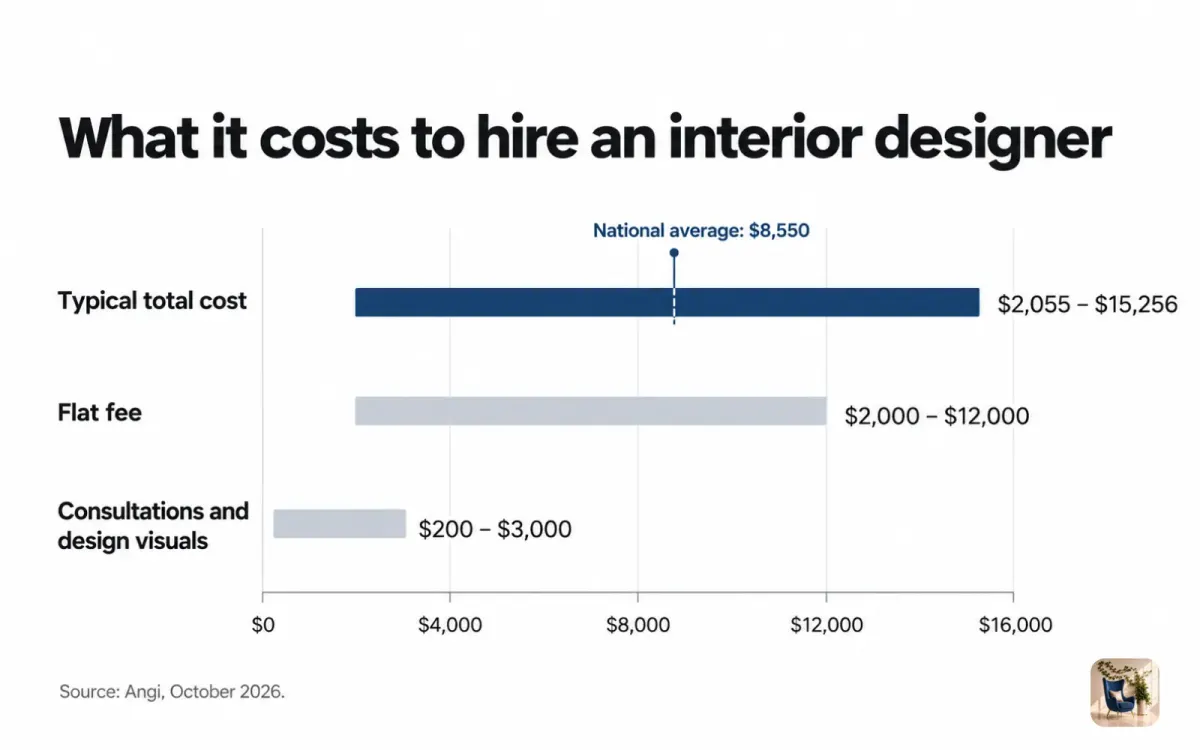
Interior designers charge a flat fee, a price per square foot, a percentage of the project, an hourly rate, or a mix. Angi's 2026 cost guide puts the national average cost of hiring a designer at $8,550, with most homeowners paying between $2,055 and $15,256. Hourly rates have their own guide, linked at the end of this post.
| Fee structure | How it works | Published range |
|---|---|---|
| Flat fee | One price for an agreed scope, such as one room | $2,000 to $12,000 (Angi) |
| Per square foot | A price tied to the size of the space | $5 to $17 per square foot (Angi) |
| Percentage of project | A share of the total project cost | 10% to 30% of the total (Angi) |
| Commission on furnishings | A markup on pieces bought through the designer | 10% to 40% (HomeAdvisor) |
Budget for the early work too. Angi puts consultations and design visuals, such as mood boards and 3D renderings, at $200 to $3,000. If the designer also manages your contractors, Angi says to expect project management fees of 10% to 30% of the total project cost.
What the contract should spell out
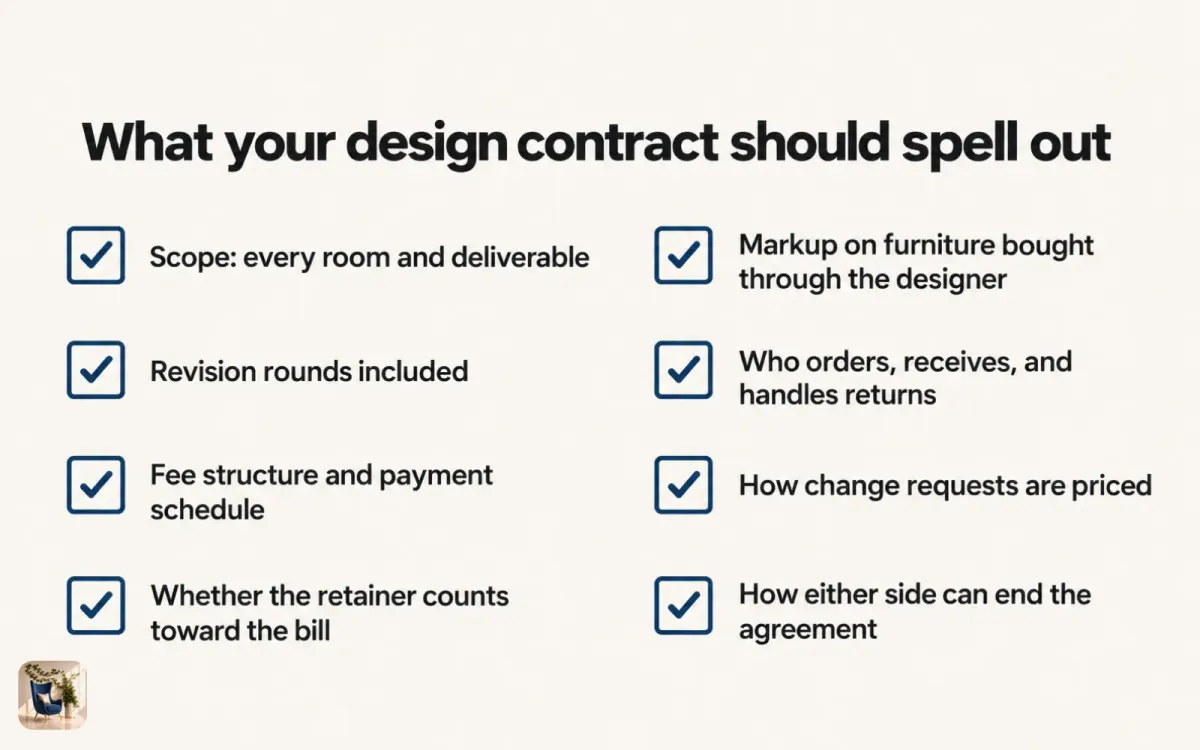
A good contract leaves nothing to memory. Before you pay a retainer, read it for the scope, the money, and the exit. The scope names every room and every deliverable, such as a floor plan, a mood board, a lighting plan, or a shopping list, plus the number of revision rounds.
The money section names the fee structure, the payment schedule, whether the retainer counts toward the final bill, and the markup on any furniture bought through the designer. The exit section says how either side can end the agreement and what you owe if they do. It also helps to see who owns the drawings, how change requests are priced, and who handles returns and damaged deliveries. If something you discussed in the interview isn't written down, ask for it to be added.
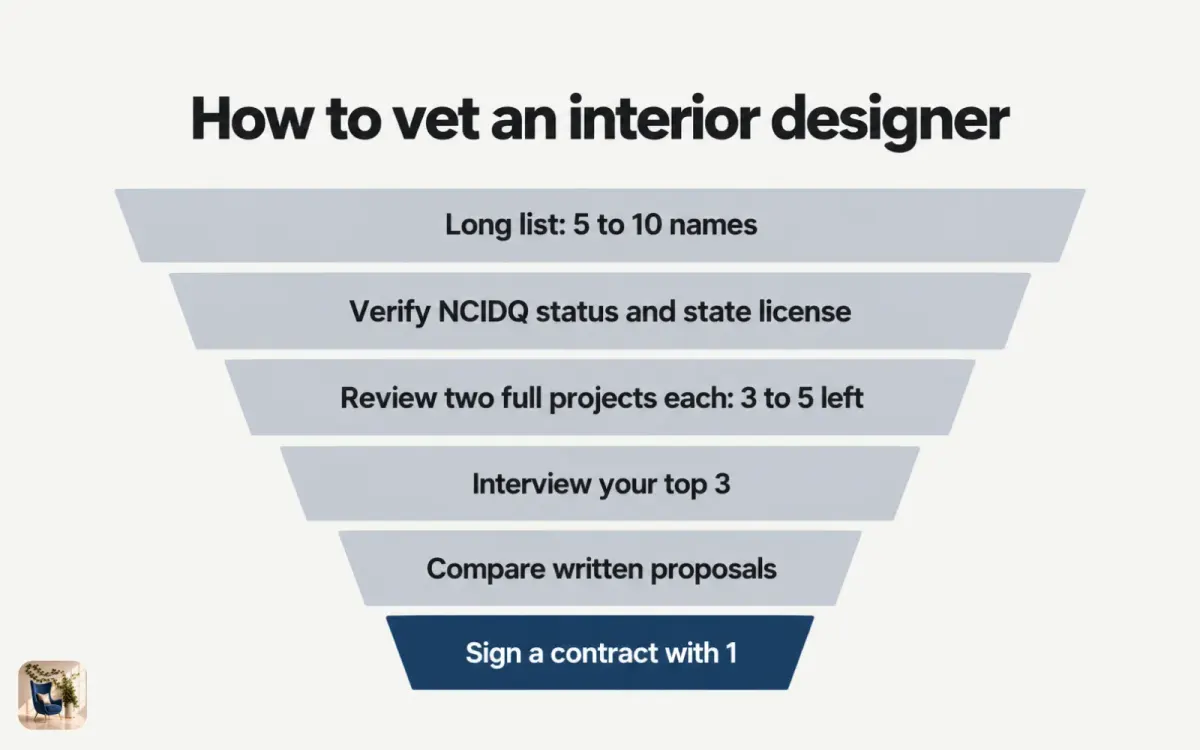
How to vet an interior designer, step by step
Most people can get from a blank search to a signed contract in seven steps.
Step 1: Write a one-page brief
List the rooms, your budget, your timeline, what must stay, and three or four looks you like. Add photos of the room taken in daylight from a corner.
Step 2: Build a long list
Pull names from ASID's Design Finder, friends and neighbors, and contractors or agents you trust. Aim for five to ten names that work in your area.
Step 3: Verify credentials
Ask each designer for their NCIDQ certificate number and expiration date and check them in MyNCIDQ on the CIDQ site. Check your state licensing board too, especially if the project involves walls, plumbing, or electrical work.
Step 4: Review two full projects each
Cut the list to three to five designers whose portfolios include complete projects near your budget and your style. Note any that only show single rooms or close-up shots.
Step 5: Interview your top three
Use the questions above and take notes on each call. Ask every designer the same questions so you can compare answers side by side afterward.
Step 6: Compare written proposals
Ask each finalist for a written proposal with the scope, the fee structure, and an estimate. Line them up and check that they cover the same work before you compare prices.
Step 7: Sign a contract before you pay
Read the contract for scope, fees, markup, and exit terms, and call one past client before you sign. Pay the retainer only after the contract is signed by both of you.
Where AI fits before you hire
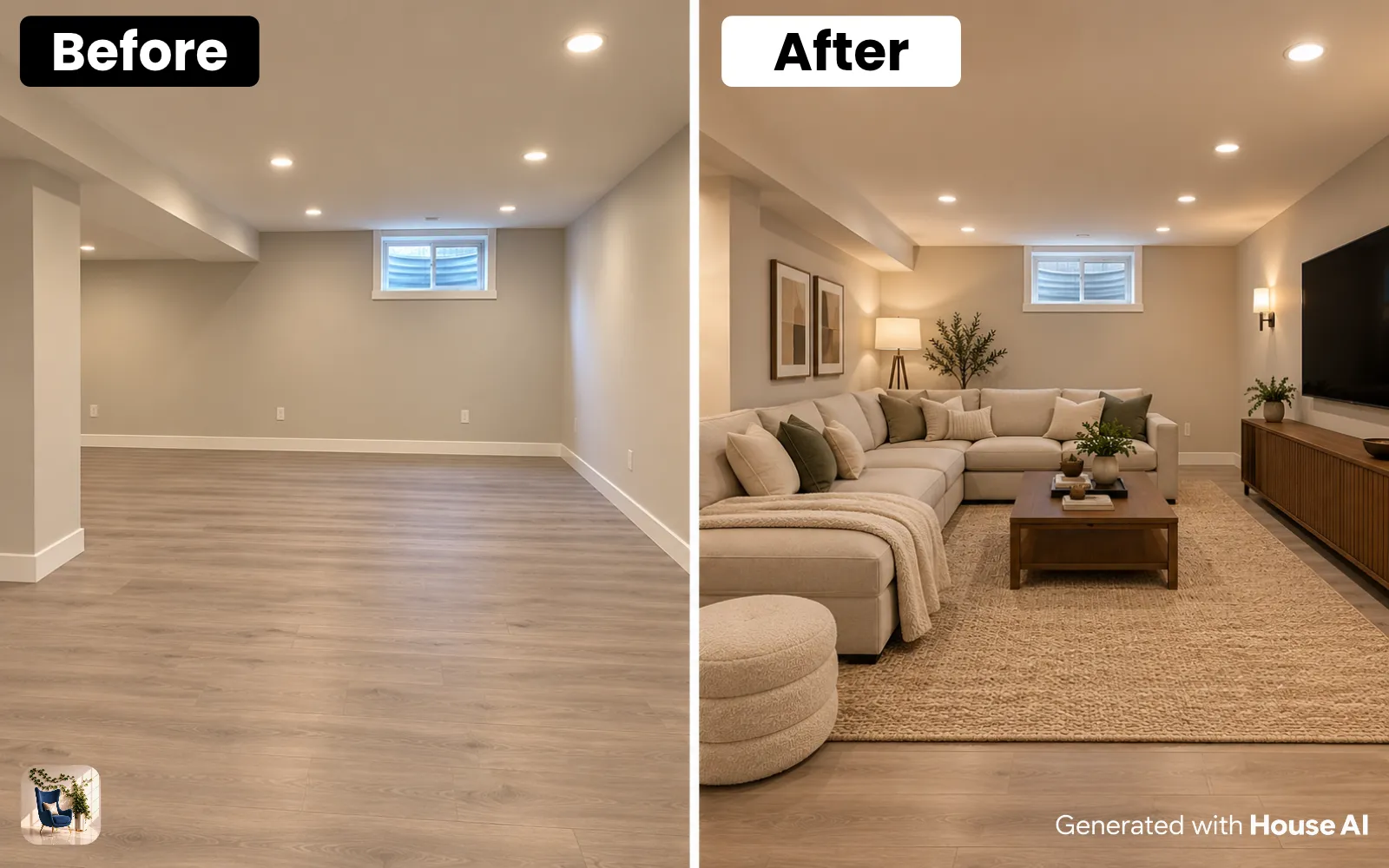
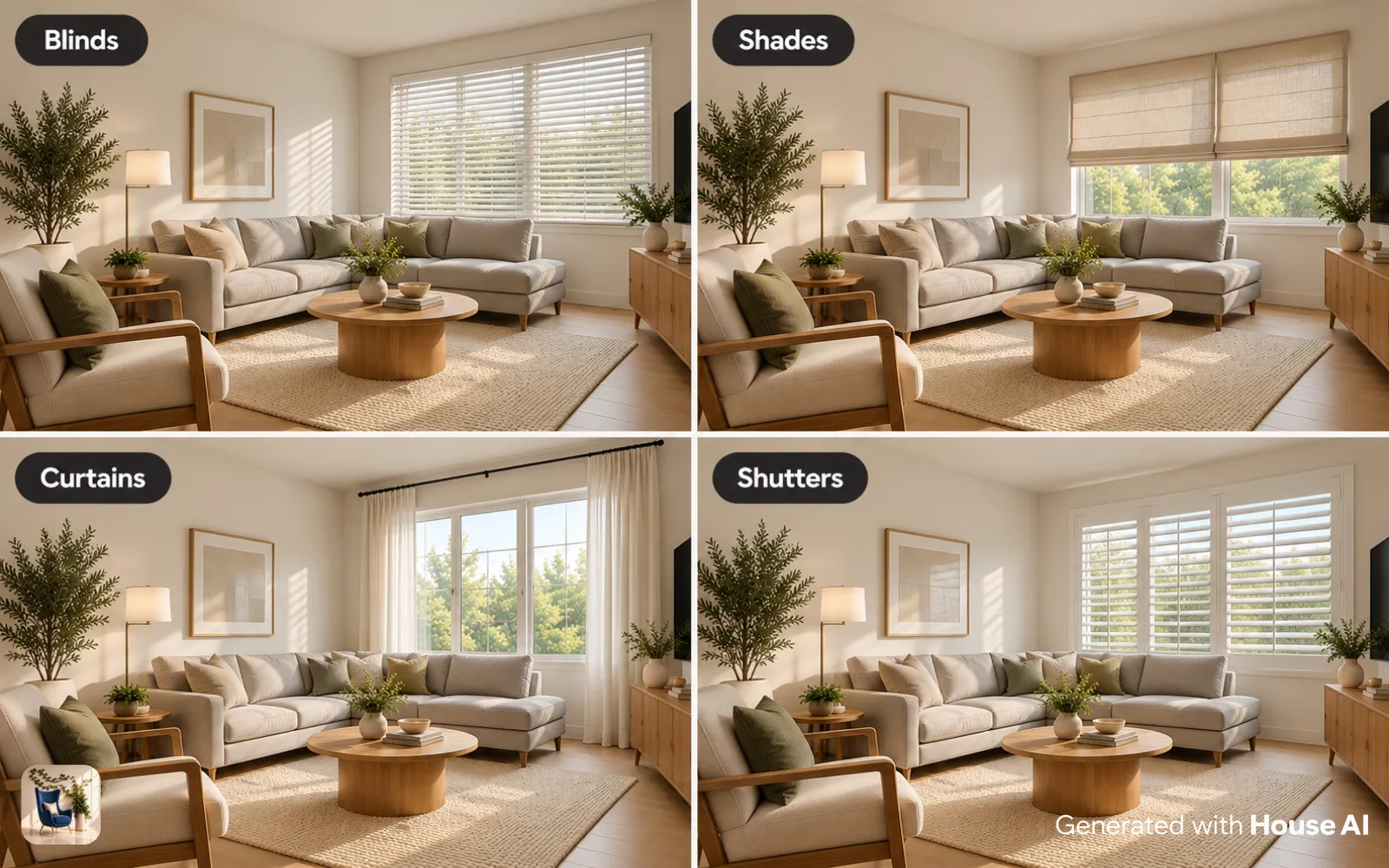
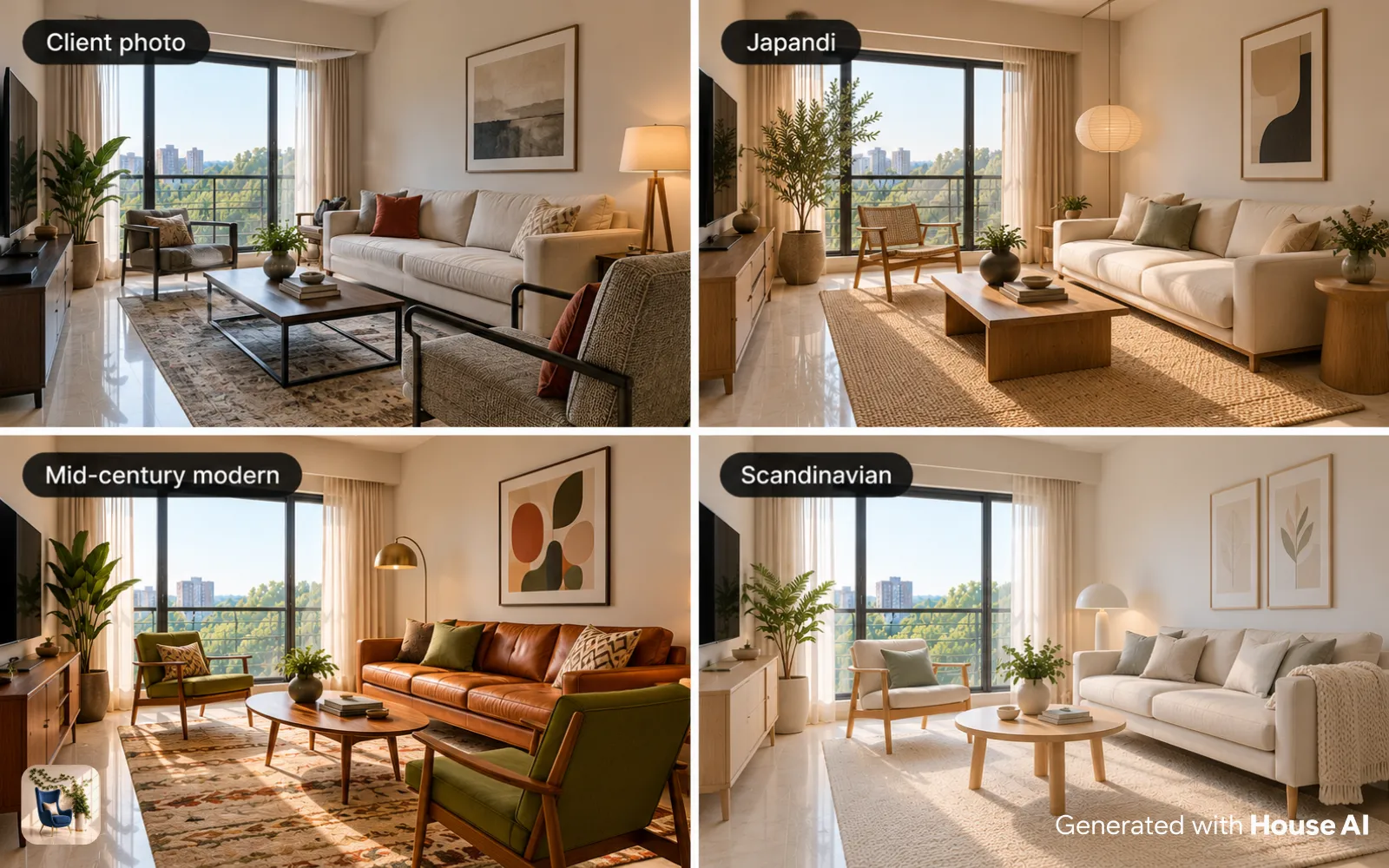
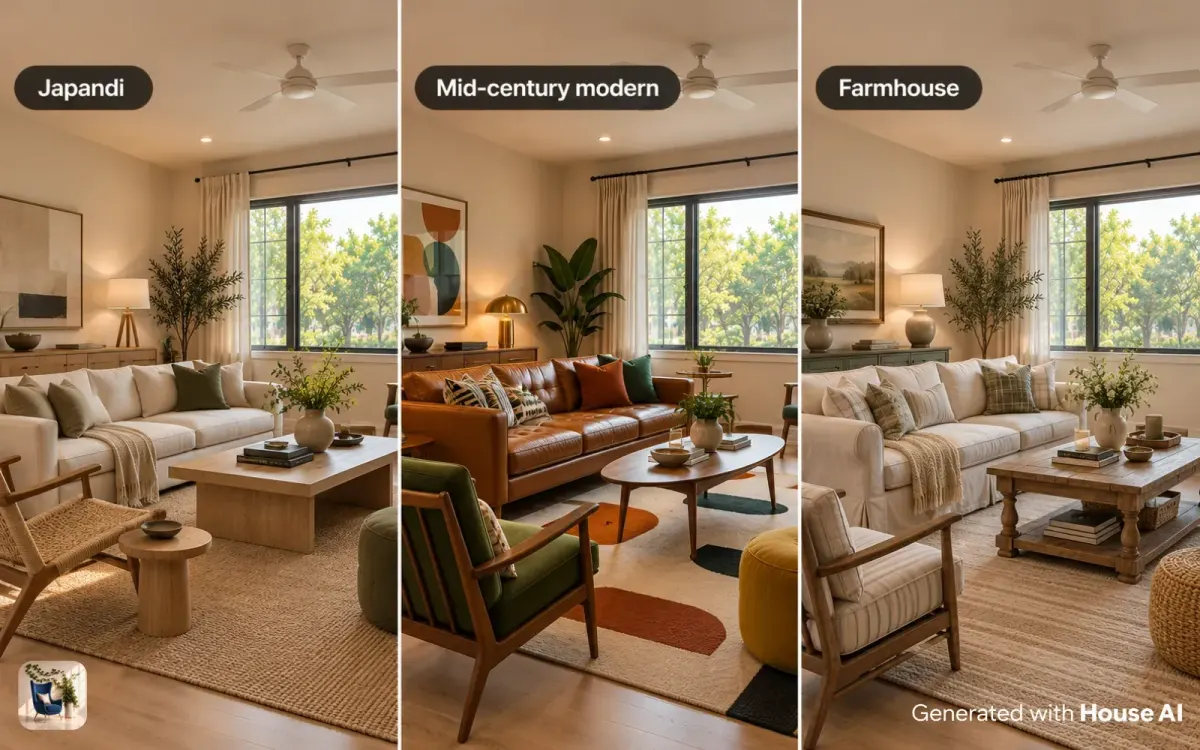
AI helps most at Step 1. Designers work faster when you can show them what you like on your own room instead of describing it. In House AI, you upload a photo, set the room type, and pick a style from the grid or describe the look in your own words. Each design takes about 15 seconds on average, and every user gets 3 free designs a day with no credit card, so you can try a few directions before the first meeting.
Be clear about the limits. House AI doesn't measure your room, so a sofa that fits the picture may not fit the wall. Small details can drift between the render and real life, and a render can't tell you whether a wall can come down or what your building code allows. Bring the renders to your designer as a picture of your taste, then let them do the measuring and planning.
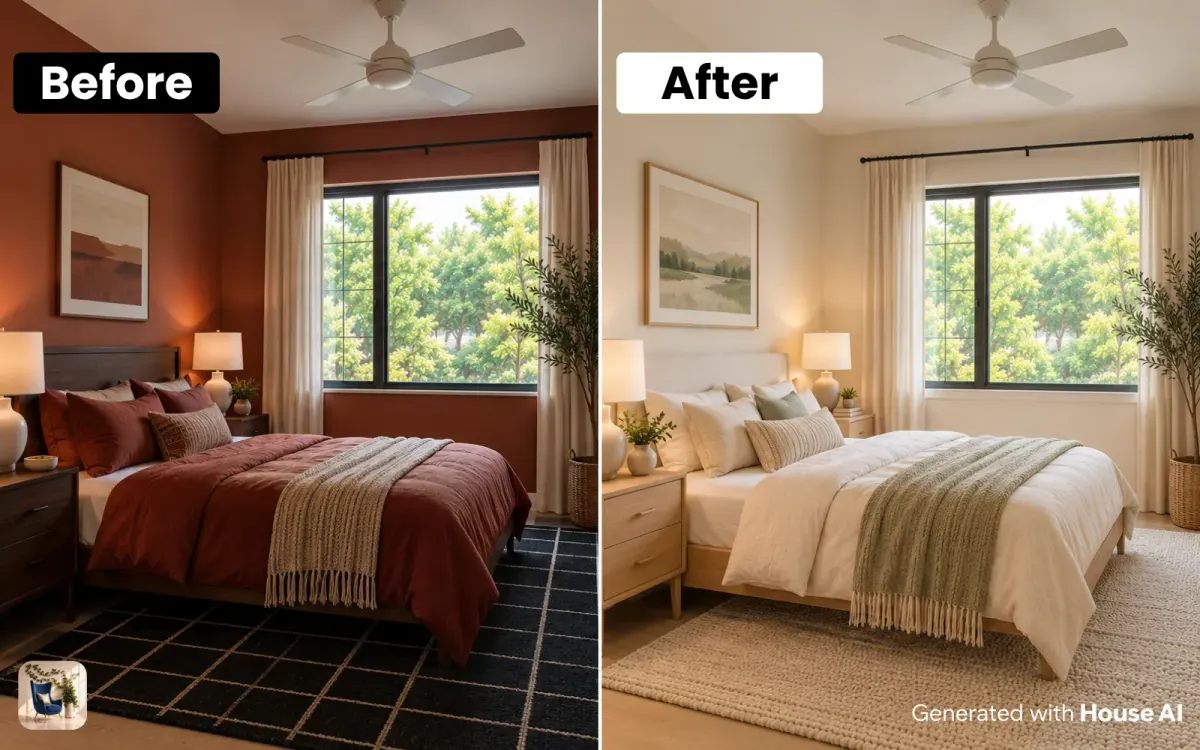
Design any room, shop or space with House AI in about 15 seconds. 1 free design a day.
Get Started TodayFrequently asked questions
How do I find a certified interior designer near me?
Start with ASID's Design Finder directory and local referrals. Then ask each designer for their NCIDQ certificate number and expiration date and verify them for free in MyNCIDQ on the CIDQ site.
How many interior designers should I interview?
Three is a good number. HomeAdvisor recommends getting quotes from at least three professionals so you can compare fees and scope.
Do interior designers need a license?
It depends on the state. The Bureau of Labor Statistics says licensure requirements vary by state, and in some states only licensed designers may do interior design work.
Do interior designers mark up furniture?
Many do. HomeAdvisor lists commissions of 10% to 40%, so ask in the interview and get the rate written into the contract.
What should I bring to a first meeting with a designer?
Bring daylight photos of the room, rough measurements, your budget, your timeline, and pictures of looks you like. AI renders of your own room in a few styles make the brief even clearer.
Keep reading
- How Much Does an Interior Designer Charge per Hour?
- What Does Interior Design Cost in 2026? Designer vs DIY vs AI
- AI vs Traditional Interior Design: Which Is Right for You?
- How Do I Find My Interior Design Style?
- What Is Interior Design? Definition, Principles, Types and Careers
Sources: Angi, "How Much Does an Interior Designer Cost? [2026 Data]," updated August 31, 2026. HomeAdvisor, "How Much Does It Cost to Hire an Interior Designer?," updated June 19, 2026. CIDQ, "Verifying Certification" and "Exams" pages, undated. U.S. Bureau of Labor Statistics, Occupational Outlook Handbook, "Interior Designers," last modified August 27, 2026. ASID, Design Finder, undated. All checked October 3, 2026. House AI figures come from the House AI app.