Interior design terms are the shared words designers, showrooms, and contractors use to describe a room and how its pieces get bought. This glossary sorts 82 of them into six groups: layout and scale, color, materials and finishes, furniture, lighting, and trade terms such as "to the trade" and COM. Each one gets a plain definition in a sentence or two.
Most design jargon is simple once someone translates it. The tricky part is that the same word can mean one thing in a paint store and another on a furniture invoice. Use the tables below as a lookup, then bring the words to your next store visit, contractor quote, or design consult.
Layout and scale terms
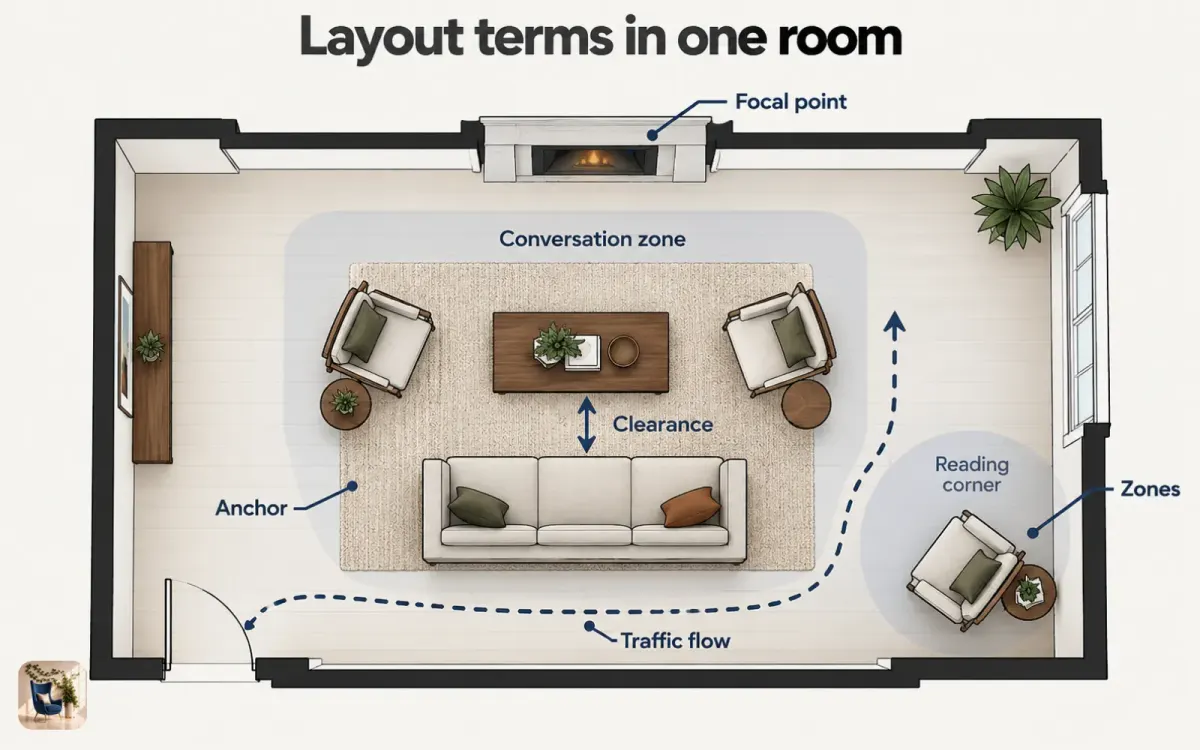
Layout words describe where things go and how people move around them. They come up first in any project, because a room that doesn't flow can't be saved by pretty fabric. The principles behind them, like balance and proportion, are covered in our guide to what interior design is, so this table sticks to definitions.
| Term | What it means |
|---|---|
| Space planning | Deciding what goes where in a room so it works for the people using it |
| Floor plan | A drawing of a room from above that shows walls, doors, windows, and furniture |
| Elevation | A flat drawing of one wall seen straight on, used for cabinets, built-ins, and art placement |
| Traffic flow | The paths people walk through a room; good flow means nobody squeezes past furniture |
| Clearance | The open space a door, drawer, chair, or walkway needs to work |
| Zoning | Splitting one room into areas with different jobs, such as a reading corner and a TV area |
| Open floor plan | A layout where the kitchen, dining, and living areas share one space without full walls |
| Focal point | The first thing your eye lands on, such as a fireplace, a window, or a bold piece of art |
| Sight line | What you can see from a given spot, such as the view from the front door into the house |
| Negative space | The empty areas around and between objects, which give the eye a rest |
| Scale | How big an object is compared with the room it sits in |
| Proportion | How the sizes of objects in a room relate to each other |
| Anchor | A large piece, usually a rug, that holds a furniture group together visually |
| Vignette | A small styled arrangement of objects on a table, shelf, or console |
Color terms
Color terms explain why two whites look nothing alike on the same wall. The three that matter most are hue, value, and undertone. Once you can name the undertone of a paint chip, picking a matching sofa or tile gets a lot easier.
| Term | What it means |
|---|---|
| Hue | The color family itself, such as red, blue, or green |
| Value | How light or dark a color is |
| Saturation | How strong or muted a color is; a high-saturation red is bright, a low one looks dusty |
| Tint and shade | A tint is a color mixed with white; a shade is a color mixed with black |
| Undertone | The subtle color under the main one, such as the pink in a warm white or the green in a gray |
| Warm and cool colors | Warm colors lean red, orange, or yellow; cool colors lean blue, green, or violet |
| Neutral | A quiet base color such as white, beige, gray, taupe, or black |
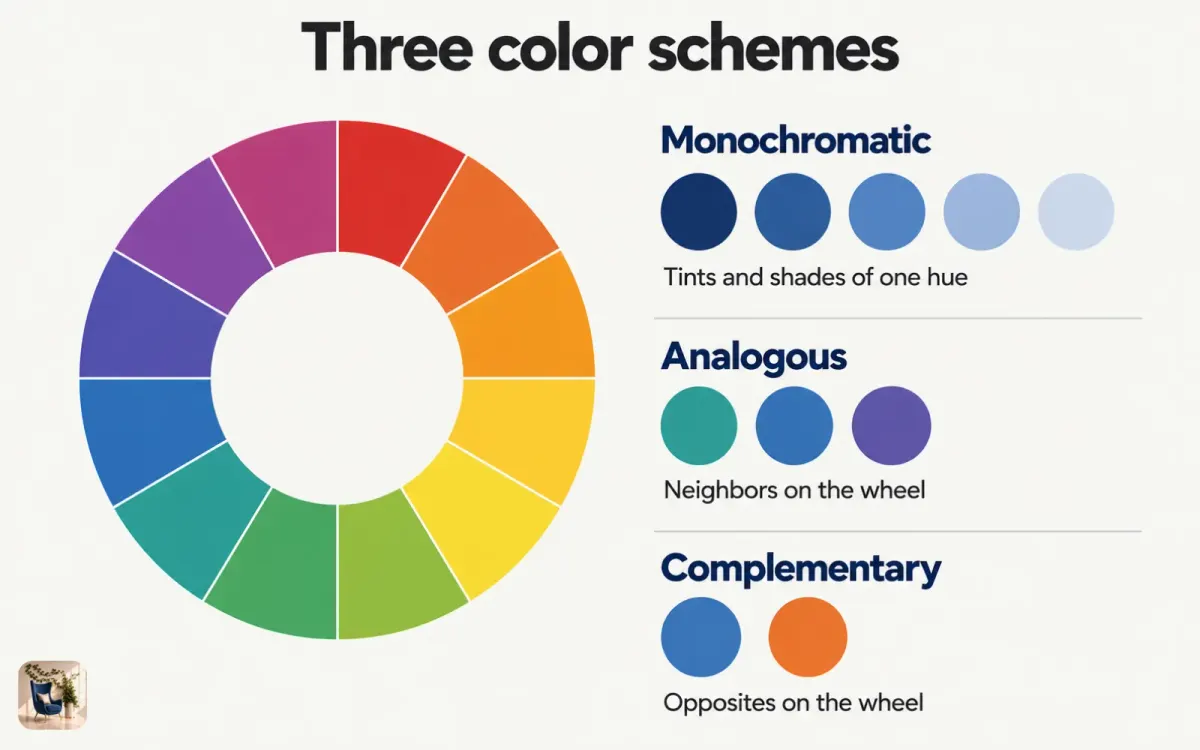
| Monochromatic | A scheme built from tints and shades of one hue |
| Analogous | A scheme built from colors that sit next to each other on the color wheel |
| Complementary | A scheme built from colors opposite each other on the color wheel, such as blue and orange |
| Accent color | A bold color used in small amounts to draw the eye |
| 60-30-10 rule | A split of about 60% main color, 30% secondary color, and 10% accent color |
| LRV | Light reflectance value, a paint rating that tells you how much light a color bounces back |
Materials and finishes terms
Finish words describe the surface you touch and the light it reflects. They decide how a room wears over time. A flat paint hides wall flaws but scuffs easily, and a gloss paint wipes clean but shows every dent.
| Term | What it means |
|---|---|
| Sheen | How shiny paint is; from dull to shiny the usual names are flat, eggshell, satin, semi-gloss, and gloss |
| Matte | A finish with little or no shine |
| Patina | The soft wear and color change that wood, leather, and metal pick up with age |
| Solid wood | Furniture made of whole pieces of lumber all the way through |
| Veneer | A thin layer of real wood glued over a cheaper core such as plywood or MDF |
| Laminate | A printed plastic surface bonded to a core, made to look like wood or stone |
| Millwork | Wood trim and built-ins made in a shop, such as moldings, paneling, and cabinets |
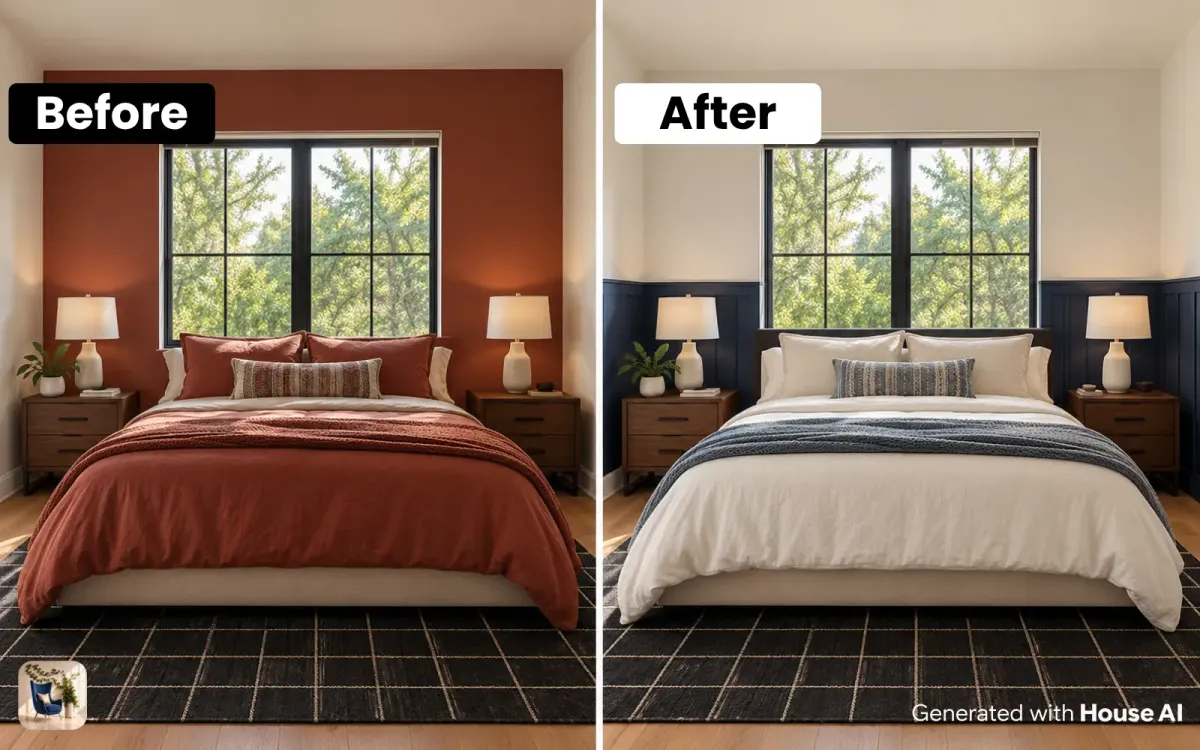
| Wainscoting | Wood paneling that covers the lower part of a wall |
| Board and batten | Wall paneling made of wide boards with thin strips covering the seams |
| Shiplap | Horizontal wood boards that overlap or fit together with a small gap between them |
| Crown molding | Decorative trim where the wall meets the ceiling |
| Boucle | A nubby fabric woven from looped yarn |
| Performance fabric | Upholstery fabric treated or woven to resist stains and wear |
| Double rubs | A lab test score for how much rubbing a fabric survives before it wears through |
Furniture terms
Furniture terms tell you what a piece is and how it is built. Two groups come up constantly. Case goods are the hard pieces with no fabric, and upholstery is anything padded and covered.
| Term | What it means |
|---|---|
| Case goods | Furniture made of hard materials with no upholstery, such as dressers, desks, and bookcases |
| Upholstery | Padded furniture covered in fabric or leather, and the fabric itself |
| Occasional table | Any small, movable table, such as a side table or a nesting table |
| Console table | A narrow table set against a wall or behind a sofa |
| Sectional | A sofa made of separate sections that join, often in an L or U shape |
| Settee | A small, upright sofa for two people |
| Chaise | A long seat you can stretch your legs out on |
| Banquette | A built-in or fixed bench, often along a wall at a dining table |
| Ottoman | A padded footstool, sometimes with storage inside |
| Etagere | An open shelving unit with several tiers for displaying objects |
| Tufting | Fabric pulled tight with buttons or stitches in a pattern, as on a Chesterfield |
| Chesterfield | A sofa with deep button tufting and rolled arms set at the same height as the back |
| Wingback | A chair with a tall back and side panels, or wings, that wrap toward the sitter |
| Tuxedo sofa | A sofa with straight arms that are the same height as the back |
Lighting terms
Lighting terms split into two kinds: what a light does and what the bulb puts out. Designers plan light in layers, so a room has a general glow, light for tasks, and a few spots of drama. One overhead fixture almost never covers all three.
| Term | What it means |
|---|---|
| Ambient lighting | The general light that fills a room, often from ceiling fixtures |
| Task lighting | Focused light for a job such as reading, cooking, or shaving |
| Accent lighting | Light aimed at art, shelves, or architecture to make them stand out |
| Layered lighting | Using ambient, task, and accent light together in one room |
| Color temperature | How warm or cool a bulb's light looks, measured in kelvins; lower numbers look warmer |
| Lumens | The amount of light a bulb gives off; more lumens means a brighter bulb |
| CRI | Color rendering index, a score for how true colors look under a light |
| Sconce | A light fixture mounted on a wall |
| Pendant | A single light that hangs from the ceiling on a cord, chain, or rod |
| Recessed light | A light set into the ceiling so it sits flush with the surface |
| Dimmer | A switch that lets you turn the light level up or down |
| Junction box | The electrical box behind a fixture where the wiring connects, often called a J-box |
Trade terms for buying through a designer
Trade terms describe how designers buy, which differs from how you shop online. The biggest one is "to the trade." It means a showroom sells only to design professionals, so you can buy those pieces only through a designer or with a trade account.
| Term | What it means |
|---|---|
| To the trade | Sold only to design professionals, not to the public |
| Trade discount | The lower price a vendor gives designers with a trade account |
| Retail price | The price the public pays |
| Net price | The price a designer pays the vendor after the trade discount |
| Markup | The amount a designer adds on top of the net price when reselling to a client |
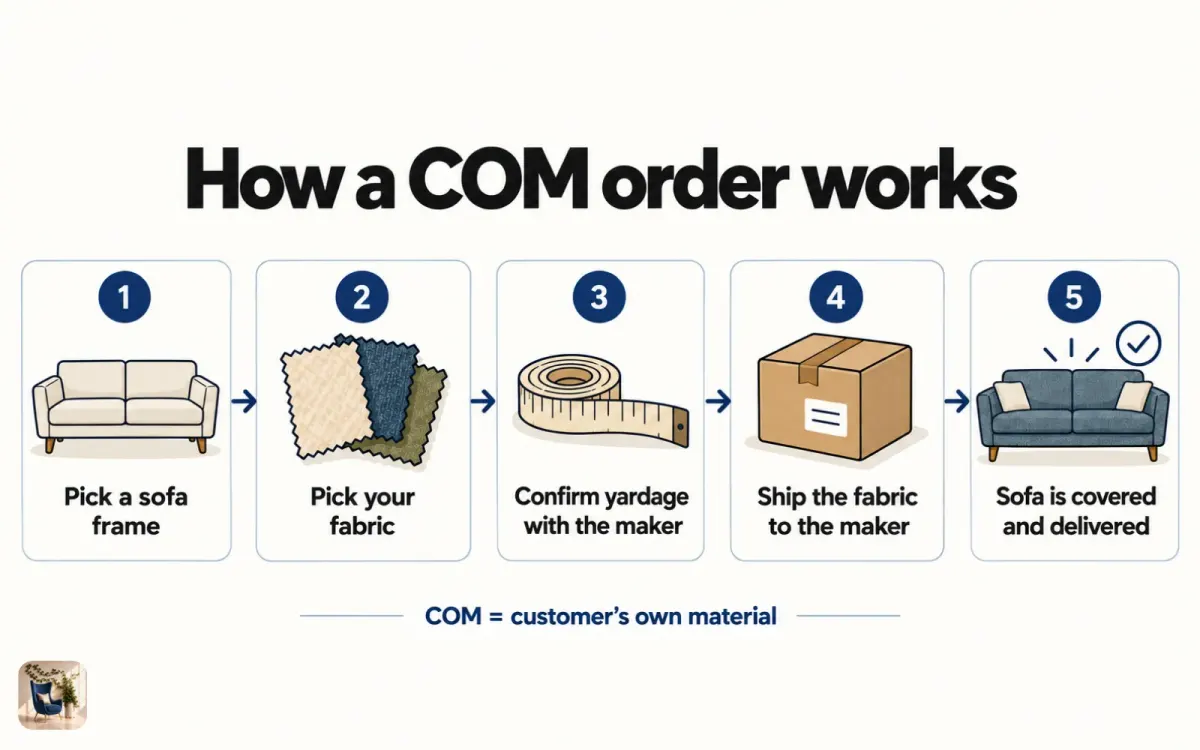
| COM | Customer's own material: you buy the fabric and the maker uses it to cover your piece |
| COL | Customer's own leather: the same idea as COM, with leather |
| Yardage | How much fabric a piece needs, given in yards |
| Memo sample | A small fabric cutting a vendor sends so you can see it in your room |
| CFA | Cutting for approval: a piece cut from the current dye lot, sent to check the color before the order |
| Lead time | How long an order takes from purchase to delivery |
| Purchase order | The formal order a designer sends a vendor, listing items, finishes, and prices |
| FF&E | Furniture, fixtures, and equipment: everything in a project that isn't built into the structure |
| White-glove delivery | Delivery that includes carrying the piece in, setting it up, and taking the packaging away |
| Punch list | The list of small fixes left at the end of a project |
COM is the trade term that trips people up most. You pick a sofa frame from one company and a fabric from another, then have the fabric shipped to the sofa maker. The yardage has to be right, and the fabric has to suit upholstery, so check both with the maker before you order.
How to use these terms when you plan a room
The words pay off when you use them to describe what you want. A clear brief saves rounds of back and forth with a designer, a salesperson, or an app.
Step 1: Name the problem with a layout term
Start with what isn't working. "The traffic flow cuts through the seating" or "the room has no focal point" tells anyone exactly where to look first.
Step 2: Describe the color by undertone
Say whether you want warm or cool, and name the undertone of the paint or fabric you already have. "Warm white with a yellow undertone" narrows a paint aisle far more than "white."
Step 3: List finishes and materials
Pick the sheen for each surface and the materials you want to see, such as matte walls, veneer cabinets, or performance fabric on the sofa. If you have kids or pets, write that down too.
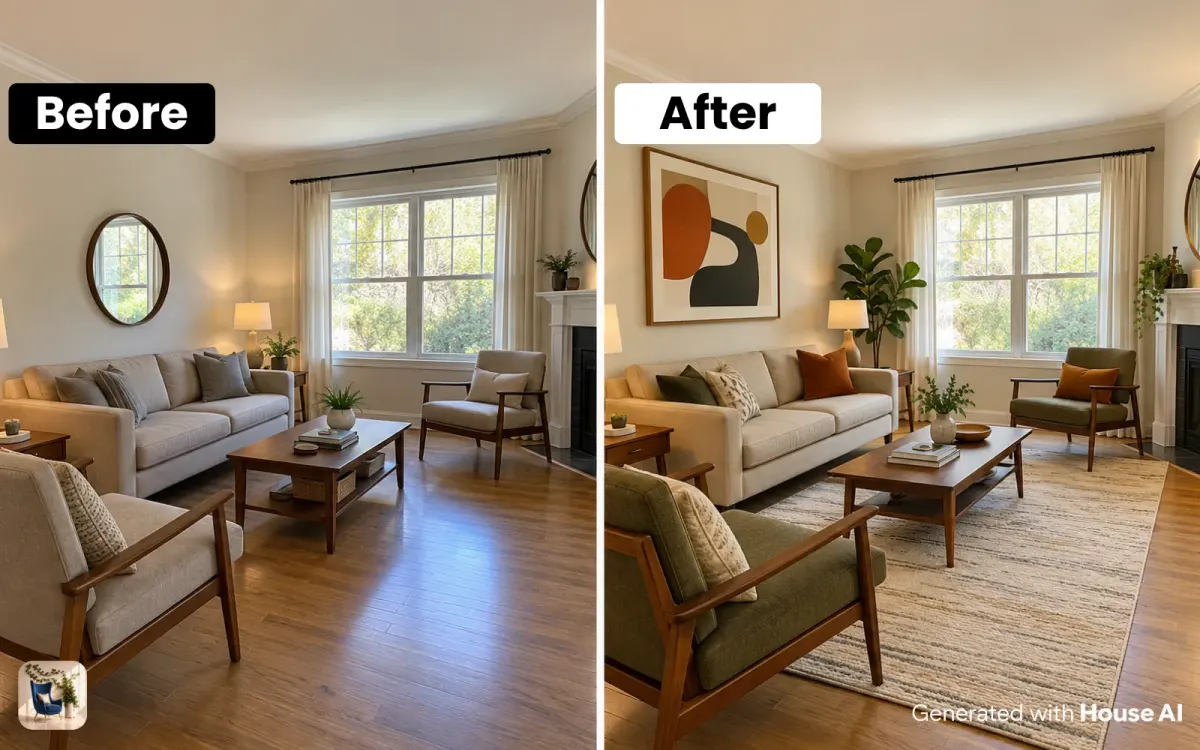
Step 4: Try the look on a photo of your room
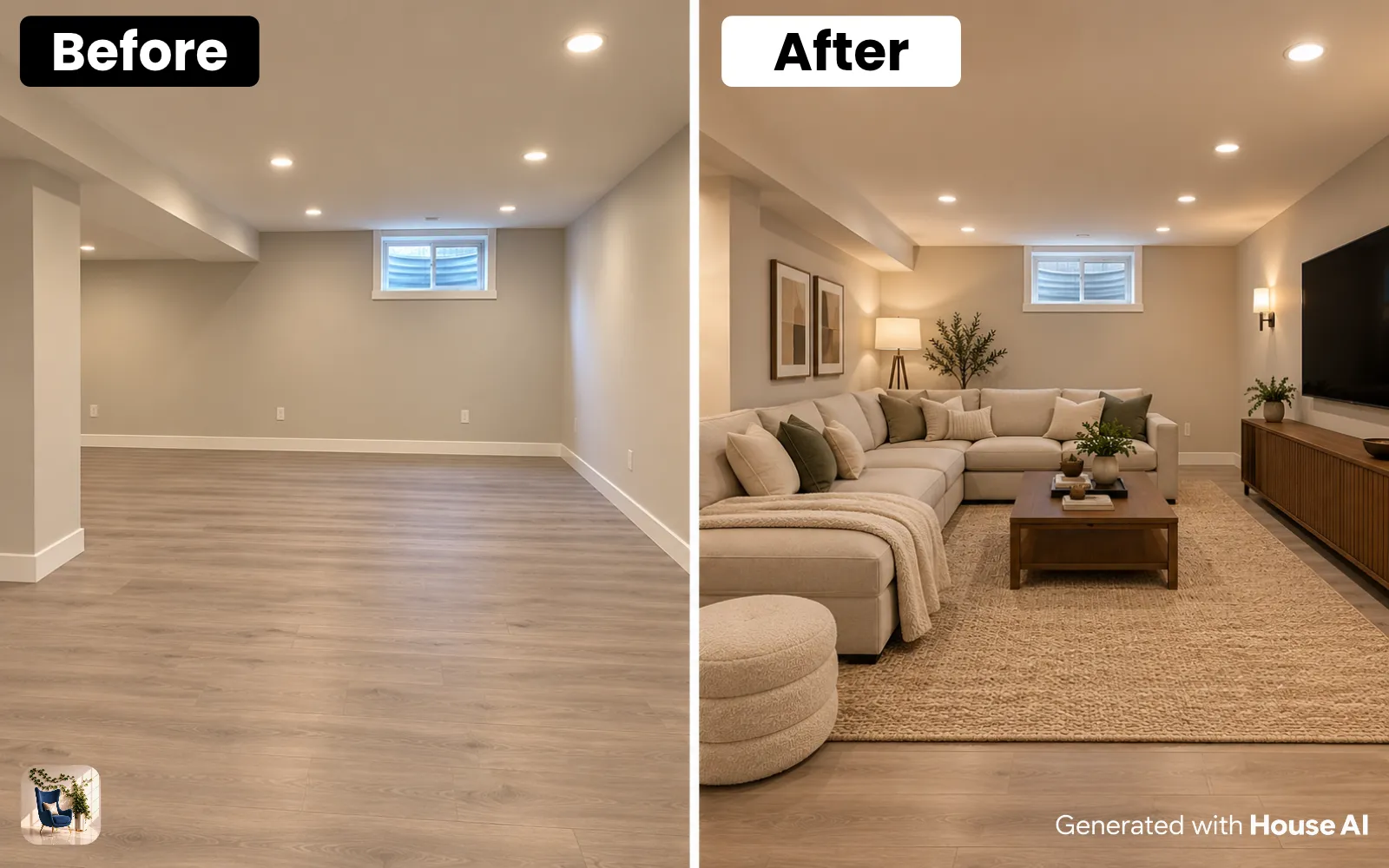
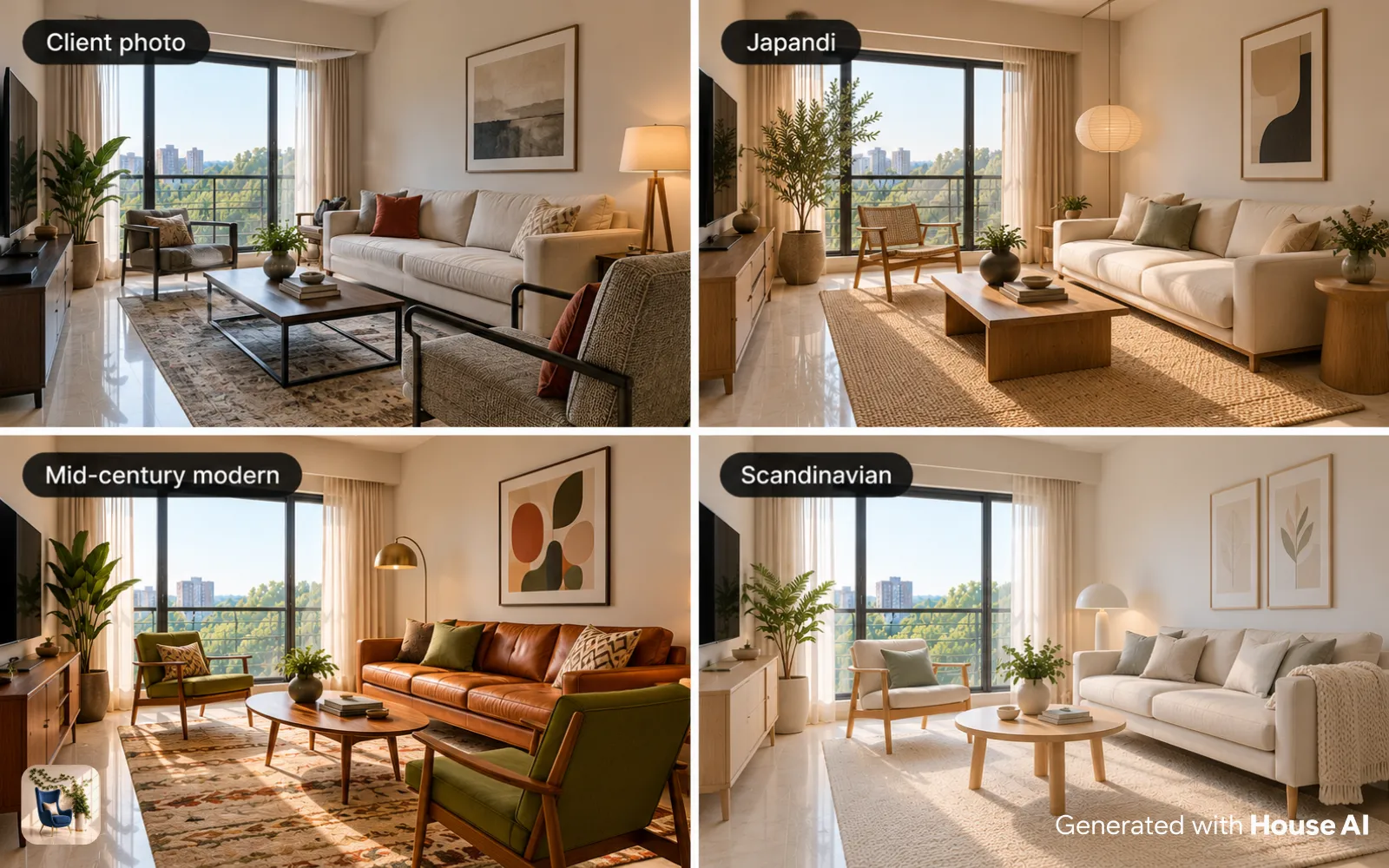
Upload a photo to House AI, set the room type, and pick from 300+ styles, or describe the look in your own words using the terms above. Each design takes about 15 seconds on average, and every user gets 3 free designs a day.
Step 5: Check sizes and lead times before you buy
AI doesn't measure your room, and small details can drift between a render and real life. Measure clearances, ask about lead time, and order a memo sample before you commit to any upholstered piece.
Terms people mix up
| Pair | The difference |
|---|---|
| Scale vs proportion | Scale compares an object with the room; proportion compares objects with each other |
| Tint vs shade | A tint adds white to a color; a shade adds black |
| Matte vs flat | Both have little shine; flat paint has the least, and matte is a broader word for any low-shine surface |
| Veneer vs laminate | Veneer is a thin layer of real wood; laminate is a printed plastic made to look like wood |
| Settee vs loveseat | Both seat two; a settee is usually more upright with exposed legs, a loveseat softer and fully upholstered |
| Net price vs retail price | Net is what the designer pays the vendor; retail is what the public pays |
Design any room, shop or space with House AI in about 15 seconds. 1 free design a day.
Get Started TodayFrequently asked questions
What does COM mean in interior design?
COM stands for customer's own material. You buy the fabric yourself and the furniture maker uses it to upholster your piece.
What does "to the trade" mean?
It means a showroom or brand sells only to design professionals with a trade account. The public can buy those pieces through a designer.
What is FF&E in interior design?
FF&E stands for furniture, fixtures, and equipment. It covers the movable items in a project, as opposed to walls, floors, and other built parts.
What is a focal point in a room?
A focal point is the first thing you notice when you walk in, such as a fireplace, a large window, or a bold piece of art. Furniture is usually arranged to face it.
What is the difference between case goods and upholstery?
Case goods are hard pieces with no fabric, such as dressers and bookcases. Upholstery is padded furniture covered in fabric or leather.
Keep reading
- What Is Interior Design? Definition, Principles, Types and Careers
- Interior Design Styles Explained: 40 Looks With Real Room Examples
- What Is the Difference Between an Interior Designer and a Decorator?
- What Size Rug Do I Need for My Living Room?
- How Long Should Curtains Be?
Sources: House AI figures come from the House AI app.